A few weeks ago I sat across from a couple in their newly opened-up West Loop two-flat, and the wife said something I hear constantly: "We knocked down the wall, and now we have no idea what to do with all this space." Their combined kitchen-dining area measured roughly 22 by 14 feet, and without a well-designed island anchoring the room, the whole layout felt like a bowling alley. That project became one of my favorite island designs this year — and it reminded me just how much the right island cabinet configuration can transform a Chicago open-floor plan.
Key Takeaways
- A kitchen island needs at least 36 inches of clearance on all sides for comfortable traffic flow — 42 inches is ideal in open-floor plans.
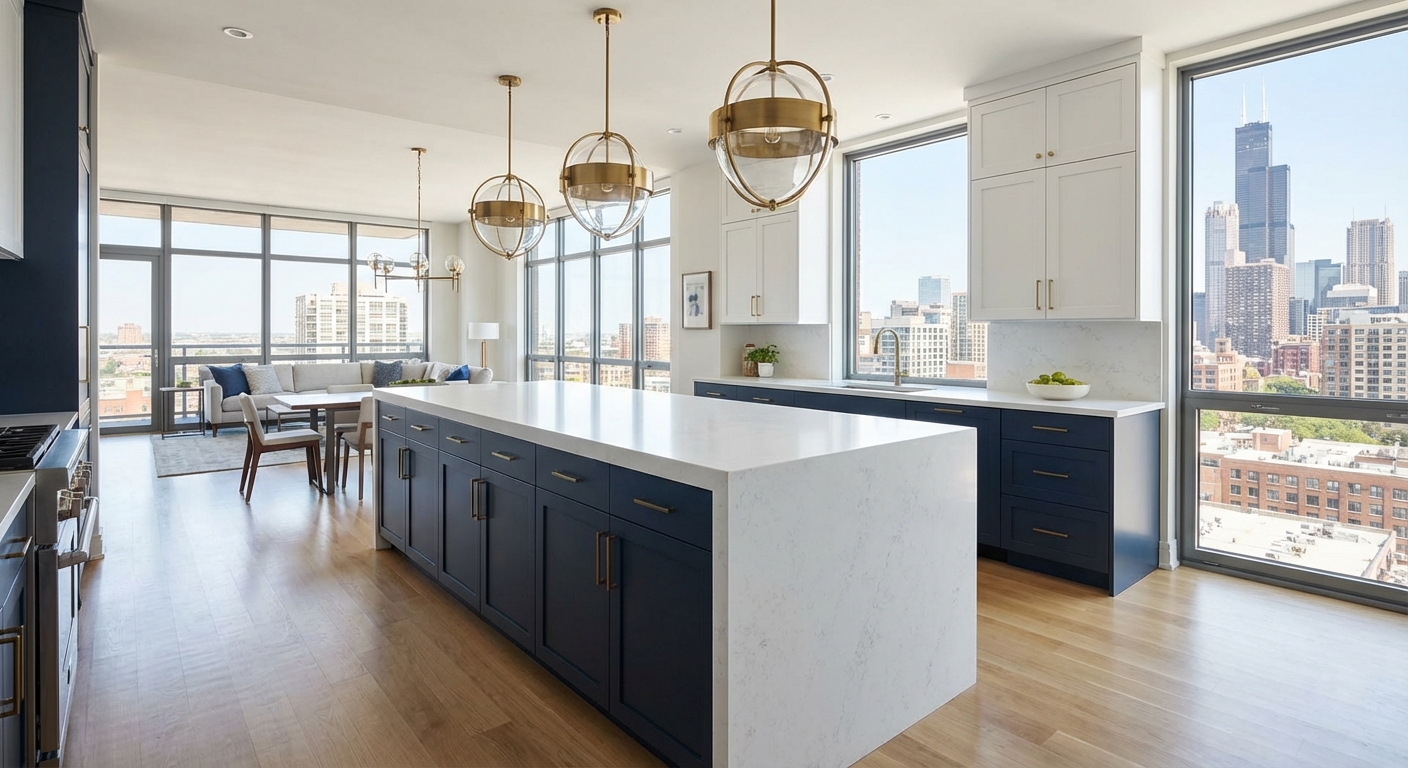
- Two-toned island cabinets are the top design trend in Chicago kitchens heading into 2026, adding visual depth without clutter.
- Islands in compact Chicago condos can start at 48 inches wide and still deliver meaningful storage with the right internal hardware.
- Waterfall countertop edges paired with slab-front cabinetry create a sleek, modern statement suited for loft-style open layouts.
- At AK Cabinet Craft, our team has completed 1,300+ projects, and islands have become part of nearly every open-floor-plan remodel we design.
Why Kitchen Island Cabinets Are the Heart of Chicago Open-Floor Plans
Once you remove a wall between your kitchen and living room — something I see happening in Bucktown two-flats and Logan Square bungalows almost weekly — you lose upper cabinetry and counter space that used to live along that partition. The island steps in to replace that lost storage while also defining zones within the open layout. Think of it as your kitchen's anchor: it tells guests where the cooking zone ends and the entertaining zone begins. In Chicago's older homes, where rooms were originally chopped into small compartments, this kind of spatial clarity is everything. A thoughtfully designed island also gives you room for a sink, cooktop, or simply a generous prep surface that faces the living area so you're never cooking with your back to the party.
What makes Chicago homes unique is the sheer variety. A 900-square-foot Lincoln Park condo demands a completely different island strategy than a 2,400-square-foot Naperville colonial. I always begin by measuring traffic paths, sight lines to windows, and existing plumbing before I even think about cabinet door styles. If you want to explore the full range of what we offer, take a look at our custom kitchen cabinets for Chicago homes — we build every island to fit the exact footprint of your space.
Popular Island Cabinet Styles I'm Designing in 2026
Design trends in Chicago have shifted meaningfully over the past two years. I'm seeing homeowners move away from the all-white, farmhouse-inspired island toward warmer, more layered looks. Here are the styles dominating my project board right now:
- Two-Tone Islands: A darker island base (think deep sage, navy, or walnut stain) paired with lighter perimeter cabinets. This contrast gives the island its own identity in the open-floor plan.
- Slab-Front Modern: Flat-panel doors with integrated pulls, often in matte finishes. This is the go-to for South Loop and West Loop loft conversions.
- Shaker with a Twist: Classic shaker profiles but in unexpected colors — charcoal, olive, even terracotta — paired with brass or matte-black Blum hardware from Austria for smooth, soft-close function.
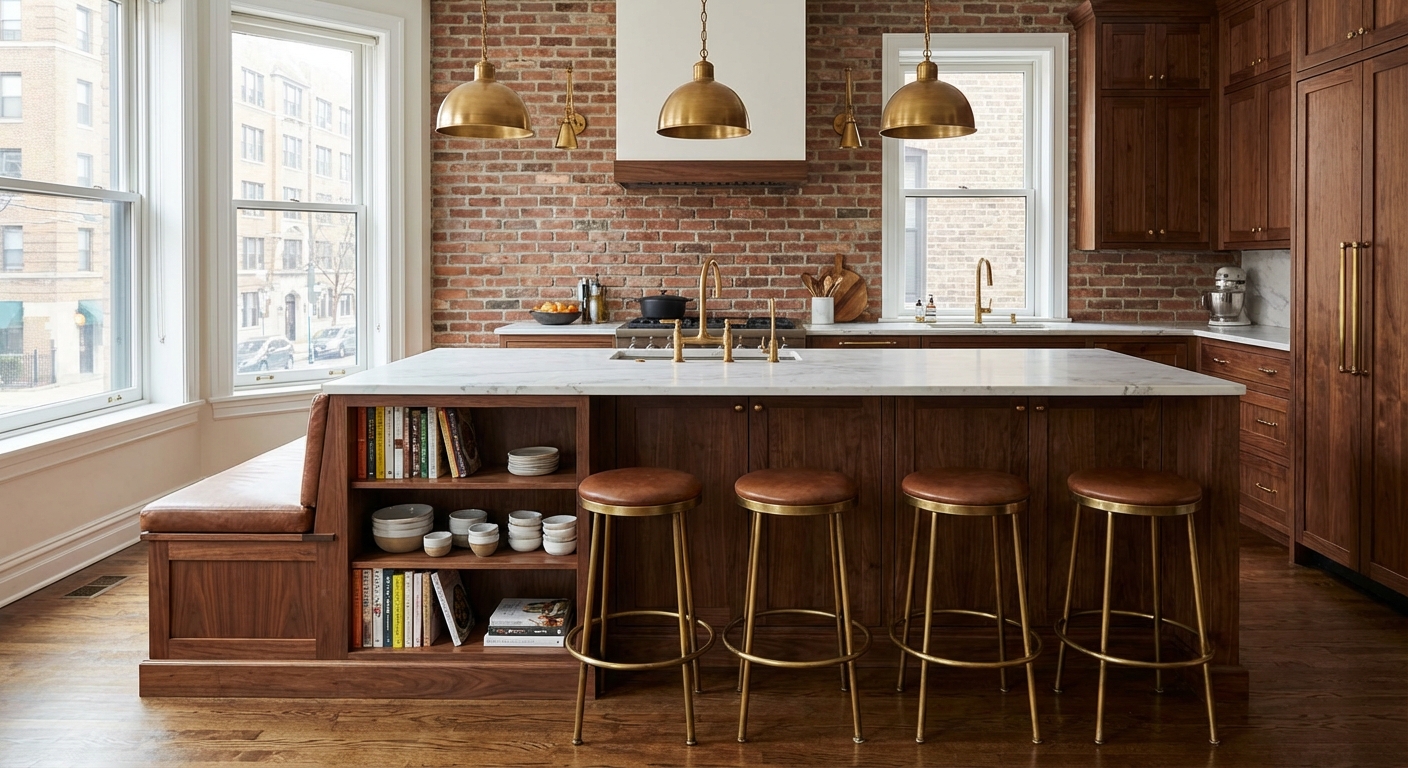
- Open-Shelf Hybrid: One end of the island features open cubbies or display shelving, giving the piece a furniture-like quality that blends into the living space.
- Fluted and Reeded Panels: Vertical texture on island end panels adds dimension without being overly ornate — hugely popular in Lakeview and Lincoln Square remodels.
All of these styles work beautifully when the cabinet boxes are built with precision. We use 3/4-inch plywood construction and Blum soft-close hinges and drawer systems across every project, which means even an island that gets heavy daily use will still feel solid years down the road. If you're curious about how dimensions affect your island design, our kitchen cabinet dimensions guide breaks down standard and custom sizing in detail.
Sizing Your Island for Chicago Home Types
One of the biggest mistakes I see is homeowners choosing an island that's either too large for the room or too small to be functional. The sweet spot depends on your home type, and in Chicago, that varies wildly. Below is a sizing reference I share with my clients during our initial design meeting.
| Chicago Home Type | Typical Kitchen Width | Recommended Island Size | Clearance Target |
|---|---|---|---|
| High-Rise Condo | 9–11 ft | 48" × 24" (compact) | 36" minimum |
| Greystone / Two-Flat | 11–13 ft | 60" × 36" (mid-size) | 42" ideal |
| Chicago Bungalow | 10–12 ft | 54" × 30" (mid-size) | 36–42" |
| Suburban Colonial / New Build | 14–18 ft | 84" × 42" or larger | 42–48" |
These are starting points, not rules carved in stone. I recently designed a 72-inch-long island for a Ravenswood bungalow where the homeowner had removed a pantry wall, and the extra length gave us room for a built-in wine cooler on the living-room side. In a Streeterville high-rise, I went the opposite direction — a 48-inch movable island on locking casters that the owner rolls aside when she hosts dinner parties. The point is that kitchen island cabinet design in Chicago demands flexibility, and custom sizing is what makes it work.
Need expert advice? Call (224) 808-5100 or schedule a free kitchen design consultation.
Storage Ideas That Make Island Cabinets Work Harder
An island without smart interior storage is just a countertop on legs. In every project I design, I push clients to think about what they'll actually store inside the island — and then we configure the cabinet interiors to match. Deep pot drawers are a staple; I specify Blum TANDEMBOX drawer systems rated for loads up to 65 pounds, which means you can stack Dutch ovens and cast-iron skillets without worry. Pull-out trash and recycling bins are another must-have, especially in open-floor plans where a visible garbage can kills the aesthetic instantly.
Here are the storage features I build into islands most frequently:
- Double-tier cutlery inserts in the top drawers for utensils and prep tools
- Pull-out spice racks next to the cooktop zone
- Vertical tray dividers for baking sheets and cutting boards
- Appliance garages with retractable doors to hide stand mixers and blenders
- Bookshelf end panels on the dining-room side for cookbooks or display
If you have awkward nooks elsewhere in your home that also need creative storage, our guide to custom built-ins for awkward spaces covers solutions beyond the kitchen. And for families tackling closet chaos alongside a kitchen remodel, our custom closet and wardrobe systems follow the same made-to-measure philosophy we use on islands.
Seating and Social Layout Considerations
In an open-floor plan, the island almost always doubles as the breakfast bar, homework station, and cocktail counter. I recommend planning for at least 24 inches of counter width per seat on the overhang side — 28 inches if you prefer a more spacious feel. The overhang itself should extend 12 to 15 inches beyond the cabinet face to accommodate knees comfortably. Counter-height seating (36 inches) keeps the surface flush with the rest of the kitchen, which creates a cleaner line in modern designs. Bar-height setups (42 inches) work well when you want a visual divider between the kitchen and living zones — I've used this approach in several Wicker Park loft conversions where the client wanted separation without a wall.
One design move I love for social kitchens: wrapping the island's seating side with a contrasting material. For instance, a kitchen I finished in Andersonville last spring paired white slab-front cabinets on the working side with a vertical walnut panel on the seating side. It made the island read as a piece of furniture from the living room, which is exactly the effect you want in an open layout. The National Kitchen and Bath Association research shows that the island has become the number-one gathering spot in American kitchens, so investing in its appearance from every angle pays off.
Material and Finish Pairings for 2026
Choosing materials for your island cabinets isn't just about looks — it's about how those finishes hold up to Chicago's humidity swings and daily kitchen abuse. I always recommend thermofoil or painted MDF for slab-front modern islands because they deliver a flawless, seamless surface. For shaker-style doors, I lean toward solid maple or birch frames with MDF center panels, which resist warping better than all-solid-wood construction in our Midwest climate. Here's a quick comparison of the material combos I'm specifying most often this year.
| Material Combo | Look | Durability | Starting Price (per linear ft) |
|---|---|---|---|
| Painted MDF Slab | Ultra-modern, smooth | High (scratch-resistant finish) | $220 |
| Stained Maple Shaker | Warm, transitional | Very high | $280 |
| Walnut Veneer Flat-Panel | Organic, luxe | High | $320 |
| High-Pressure Laminate (EGGER) | Versatile, wood-grain or solid | Very high | $190 |
We source our laminate options from EGGER, a European manufacturer known for realistic textures and consistent quality. For hardware across every material, we standardize on Blum — their CLIP top hinges and LEGRABOX drawers are what allow us to offer a 5-year warranty on every cabinet we produce. If you're comparing island cabinetry to bathroom projects, the same materials and hardware translate beautifully into our custom bathroom vanity designs.
Lighting and Electrical Planning for Island Cabinets
I always remind clients that the island's cabinet design doesn't stop at the wood — what happens above and inside the island matters just as much. Pendant lighting is the most popular choice, and I recommend hanging fixtures 30 to 36 inches above the countertop surface for optimal task light without blocking sight lines across the open floor plan. Under-counter LED strips inside glass-front cabinet sections or along the toe kick create an ambient glow that makes the island float at night. Plan for at least two duplex outlets on the seating side and one on the working side — Chicago code requires GFCI protection for any island receptacle. I also like to spec a pop-up power tower recessed into the countertop for charging phones and laptops, especially in homes where the island serves as a remote-work station. Getting the electrical rough-in right before cabinets arrive saves thousands in change orders, so I coordinate with our clients' electricians early in the process.
Our Process: From Concept to Installed Island in 21 Days
At AK Cabinet Craft, our production timeline is 21 days from final design approval to completed cabinets ready for installation. That speed comes from manufacturing everything locally in the Chicago area, which also means I can visit the shop floor to check your island panels in person before they ship. The process starts with a free in-home measurement — I bring a laser measure and a laptop loaded with 3D rendering software so you can see your island in the context of your actual open-floor plan before a single board is cut. We review material samples, hardware options, and finish colors on-site, then I finalize construction drawings within 48 hours. Once you approve, production begins immediately. Browse our completed projects gallery to see island designs we've delivered across Chicago neighborhoods — from compact Printer's Row condos to expansive Hinsdale kitchens.
Every island we build ships with Blum soft-close hardware, 3/4-inch plywood boxes, and our 5-year warranty. Full kitchens — island included — start from $15,000, which makes custom cabinetry far more accessible than most Chicago homeowners expect.
Frequently Asked Questions
What is the minimum kitchen size for an island in a Chicago condo?
I typically recommend at least 10 feet of kitchen width to fit even a compact island while maintaining 36 inches of clearance on each side. In tighter spaces, a rolling cart or a peninsula attached to the wall is often a smarter use of square footage.
How much does a custom kitchen island cost in Chicago?
Island cabinetry alone generally ranges from $3,000 to $8,000 depending on size, material, and internal accessories. When you factor in countertop, plumbing, and electrical, a fully loaded island can run $7,000 to $18,000. At AK Cabinet Craft, complete kitchen packages including the island start from $15,000.
Can I add a sink or cooktop to my island?
Absolutely, and I do it in about 40% of my island designs. The main consideration is plumbing and ventilation access. In slab-on-grade Chicago bungalows, running a drain line to a center island can be more involved than in homes with a basement, so I always recommend discussing this at the measurement stage.
What cabinet door style works best for an open-floor-plan island?
I lean toward slab-front or thin-rail shaker doors because they read cleanly from across the room. In an open layout, your island is visible from the living and dining areas, so overly ornate raised-panel doors can look busy. Two-toned schemes — a bold island against neutral perimeter cabinets — also help the island stand out as an intentional design feature.
How long does island cabinet installation take?
Cabinet installation for a standard island typically takes one day. If we're incorporating plumbing, electrical, or a waterfall countertop, the full installation wraps up in 2 to 3 days once all trades are coordinated.
Ready to Get Started?
Your open-floor plan deserves an island that works as hard as it looks. Whether you're reimagining a Wrigleyville greystone or building out a brand-new Fulton Market condo, I'd love to walk through your space and sketch out ideas tailored to your layout, storage needs, and style. Schedule a free kitchen design consultation or call (224) 808-5100 — and let's design the island that pulls your whole kitchen together.