Two weeks ago, I pulled apart a set of cherry cabinets in a 1940s Ravenswood bungalow — the homeowner had lived with them for 22 years and wanted to know if cherry was still the right call for her full kitchen remodel. Those doors had survived two decades of Chicago summers (we're talking 75-85% relative humidity in July) with minimal warping. It was a perfect case study for what the right wood species can handle in this climate, and what happens when you pick the wrong one.
Key Takeaways
- Hard maple scores 1,450 on the Janka hardness scale, making it the most dent-resistant of the three species for high-traffic Chicago kitchens.
- White oak's closed-grain structure resists moisture absorption better than red oak, cherry, or maple in Chicago's 20-85% seasonal humidity swings.
- Cherry darkens significantly within 6-12 months of UV exposure — plan your finish strategy around this natural patina shift.
- All three species perform well in Chicago when kiln-dried to 6-8% moisture content before fabrication.
- At AK Cabinet Craft, our team builds solid-wood cabinet doors on ¾-inch plywood boxes — never particle board — to prevent seasonal movement from compromising the structure.
Why Chicago's Climate Is Brutal on Cabinet Wood
Chicago isn't just cold in winter. The real killer for wood cabinets is the swing — from bone-dry forced-air heat at 15-20% indoor humidity in January to the muggy 65-80% we get lakeside in August. That seasonal delta of 50+ percentage points causes wood to expand and contract repeatedly, stressing joints, cracking finish, and eventually warping doors. I've been building cabinets for 14 years, and the material failures I see most often trace back to species selection that ignored this reality.
Wood is hygroscopic — it absorbs and releases moisture constantly. Different species absorb at different rates, which means some handle Chicago's extremes gracefully while others fight it every season. The National Kitchen and Bath Association recommends maintaining indoor humidity between 35-55% year-round for cabinet longevity, but I know most Chicago homeowners don't run humidifiers in winter or dehumidifiers in summer. Your wood species needs to forgive that.
I always tell my clients: pick a species that tolerates the climate you actually live in, not the climate you wish you had. Grain structure, density, and natural oil content all play a role. Let me walk you through the three species I install most often and how each one holds up in real Chicago homes over real Chicago years.
Red Oak vs. White Oak: Not All Oak Is Equal
Oak is the most requested wood species I work with at AK Cabinet Craft, but I always ask the follow-up question: red or white? They look similar to most homeowners, but their cellular structures are completely different. Red oak has open pores — think of tiny straws running through the grain — that absorb moisture faster and deeper. White oak has tyloses, natural plugs that seal those pores shut. In a city where your kitchen can feel like a swamp in July, that distinction matters enormously.
White oak scores 1,360 on the Janka hardness scale versus red oak's 1,290. That's close, but the moisture resistance gap is wide. I've seen red oak cabinet doors in Wicker Park condos develop visible grain raise within 3-4 years because the owner cooked frequently without proper ventilation. White oak doors in similar conditions? Still flat. For custom kitchen cabinets in Chicago homes, I steer clients toward white oak almost every time unless budget dictates otherwise.
Red oak does cost less — typically $8-12 per board foot versus $10-16 for white oak — but the long-term performance difference makes white oak the better investment. The pronounced grain of red oak also limits its versatility in modern designs, while white oak's tighter, more linear grain works beautifully in everything from shaker to slab-front doors.
Hard Maple: The Workhorse for High-Traffic Kitchens
If a client tells me they have kids, dogs, and a habit of slamming drawers, I reach for hard maple. At 1,450 Janka, it's the hardest of the three species I'm comparing here, and it takes a beating without denting the way cherry does. The grain is tight and uniform, which means it finishes to an almost glass-smooth surface — ideal for painted cabinets where you don't want texture telegraphing through.
Maple's tight grain is also its humidity advantage. It absorbs moisture more slowly than open-grained species, giving it a natural buffer against Chicago's seasonal swings. I typically kiln-dry maple to 6-7% moisture content before milling, and I've measured expansion rates of only 1/16 inch across a 24-inch door over a full year of Chicago weather. That's well within tolerance for properly built frame-and-panel construction.
The downside? Maple can yellow over time under certain finishes, especially oil-based polyurethane. I use water-based conversion varnish on all maple doors to keep the color neutral. Maple also tends to blotch if you try to stain it dark — it absorbs stain unevenly because the grain is so tight. For stained applications, I recommend either a pre-stain conditioner or switching to oak entirely.
- Best for: painted cabinets, high-traffic kitchens, families with children
- Janka hardness: 1,450
- Board foot cost: $7-11
- Stain compatibility: poor without conditioner; excellent for paint
- Chicago humidity performance: excellent — slow absorption, minimal movement
Need expert advice? Call (224) 808-5100 or schedule a free kitchen design consultation.
Cherry: Beautiful but Demanding
Cherry is the most opinionated wood I work with. It has a rich, warm tone that no stain on maple or oak can truly replicate — but it comes with behaviors you need to plan for. The most dramatic is photosensitivity: cherry darkens from a light salmon-pink to a deep reddish-brown within 6-12 months of UV exposure. If you install cherry cabinets and leave a cutting board on the counter against a door, you'll have a lighter rectangle permanently etched into the patina.
At 950 Janka, cherry is significantly softer than maple or oak. I've seen dents from dropped cans and scratches from drawer hardware in kitchens less than two years old. That softness means cherry works best in kitchens where the homeowner values aesthetics and treats the space gently. It's a popular choice for formal kitchens in Lincoln Park greystones and North Shore homes, but I wouldn't recommend it for a rental property or a household with young kids.
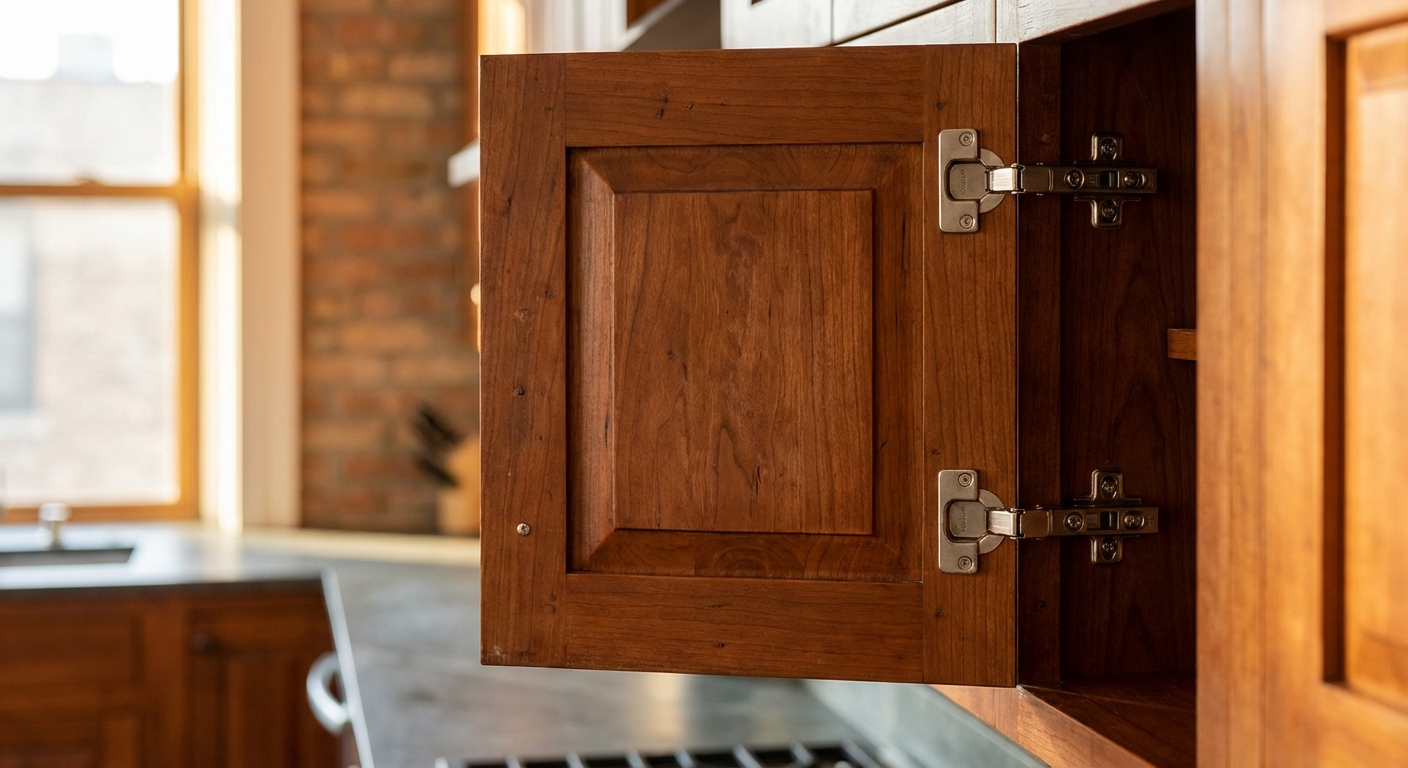
In terms of humidity performance, cherry is middle-of-the-road. Its grain is closed but not as tight as maple, and it expands about 3.7% tangentially from green to oven-dry. In a properly climate-controlled Chicago home, that translates to manageable movement if the doors are built with floating panels. I always use Blum soft-close hinges on cherry doors — the gentle closure prevents the impact damage that this softer wood is prone to.
Cherry does stain beautifully and evenly, which is its major advantage over maple. If you want a rich, warm-toned stained cabinet door, cherry is the species that delivers the most consistent color without blotching. I've installed cherry in dozens of Chicago kitchens, and the ones that age best are always in homes where the owner embraced the darkening process rather than fighting it.
Oak, Maple, and Cherry Compared: The Full Breakdown
I built this comparison table based on my shop's real-world experience across 1,300+ completed projects in the Chicagoland area. These aren't textbook numbers — they reflect what I've seen on job sites, in follow-up visits, and when I've torn out failing cabinets installed by other shops. Every species has a sweet spot, and the table below helps you find yours.
| Property | White Oak | Hard Maple | Cherry |
|---|---|---|---|
| Janka Hardness | 1,360 | 1,450 | 950 |
| Board Foot Cost | $10-16 | $7-11 | $9-14 |
| Humidity Resistance | Excellent (closed pores) | Very Good (tight grain) | Good (moderate density) |
| Stain Compatibility | Excellent | Poor (blotches easily) | Excellent |
| Paint Compatibility | Good | Excellent | Good (but why paint cherry?) |
| Color Stability | Stable; ambers slightly | Yellows under oil finish | Darkens dramatically in 6-12 months |
| Best Application | Stained shaker, modern slab | Painted cabinets, high traffic | Formal stained kitchens |
| Chicago Performance (14-yr observation) | ★★★★★ | ★★★★☆ | ★★★☆☆ |
The data speaks clearly: white oak is my top recommendation for most Chicago kitchens. It handles the humidity swings, takes stain like a dream, and has enough hardness to resist everyday abuse. Maple wins if you're painting. Cherry wins if aesthetics are your top priority and you understand the maintenance commitment. When I help clients choose during our custom kitchen cabinet design process, these are exactly the trade-offs we walk through together.
Moisture Content and Kiln-Drying: The Hidden Variable
No matter which species you choose, improperly dried lumber will fail in Chicago. I've pulled apart cabinets from big-box stores where the doors were fabricated from wood at 12-14% moisture content — that's practically green for interior cabinetry. When that wood hit a Chicago winter with forced-air heat running at 15% humidity, it shrank, cracked, and split at the joints within the first season.
At AK Cabinet Craft, every board that enters our shop is kiln-dried to 6-8% moisture content, verified with a pin-type moisture meter before milling. I then acclimate the lumber in our climate-controlled shop for a minimum of 5 days before cutting. This is non-negotiable. The difference between a cabinet door that stays flat for 20 years and one that cups in 2 years often comes down to this single preparation step.
I also use ¾-inch hardwood plywood for all cabinet boxes rather than solid wood. Plywood's cross-laminated construction makes it dimensionally stable — it doesn't expand and contract the way solid boards do. This is especially important for custom cabinets built for any room in your home, where humidity levels can vary dramatically between a basement bar and a second-floor bathroom. For a deeper dive on construction dimensions, check out our kitchen cabinet dimensions guide.
Finish Matters as Much as Species
Even the best wood species will fail if the finish doesn't seal it properly against Chicago's moisture swings. I use catalyzed conversion varnish on all our doors — it creates a harder, more moisture-resistant film than polyurethane and cures chemically rather than by evaporation. This gives us 95%+ moisture exclusion compared to roughly 80% for a standard poly coat.
For painted maple cabinets, I spray a primer coat, sand to 320 grit, then apply two topcoats of pigmented conversion varnish. Total dry film thickness ends up around 4-5 mils — enough to create a genuine moisture barrier while still looking like a factory finish. For stained oak or cherry, I use a pre-catalyzed clear coat that doesn't amber the way traditional oil-based finishes do.
I've seen "natural" or "raw" wood finishes trending on social media in 2026, and I always counsel caution. In a dry climate like Arizona, you might get away with a matte penetrating oil. In Chicago? That unprotected wood will absorb cooking moisture, swell at the edges, and develop mold in the cabinet interior within a couple of years. A sealed finish isn't optional here — it's structural protection. If you're planning built-ins for other rooms, the same principles apply; our guide to custom built-ins for awkward spaces in Chicago homes covers this in detail.
My Recommendation by Chicago Home Type
After 14 years of building and installing cabinets across every neighborhood from Rogers Park to Beverly, I've developed specific recommendations based on home type. A hermetically sealed high-rise condo on Lake Shore Drive has different humidity behavior than a drafty two-flat in Pilsen. Here's how I break it down:
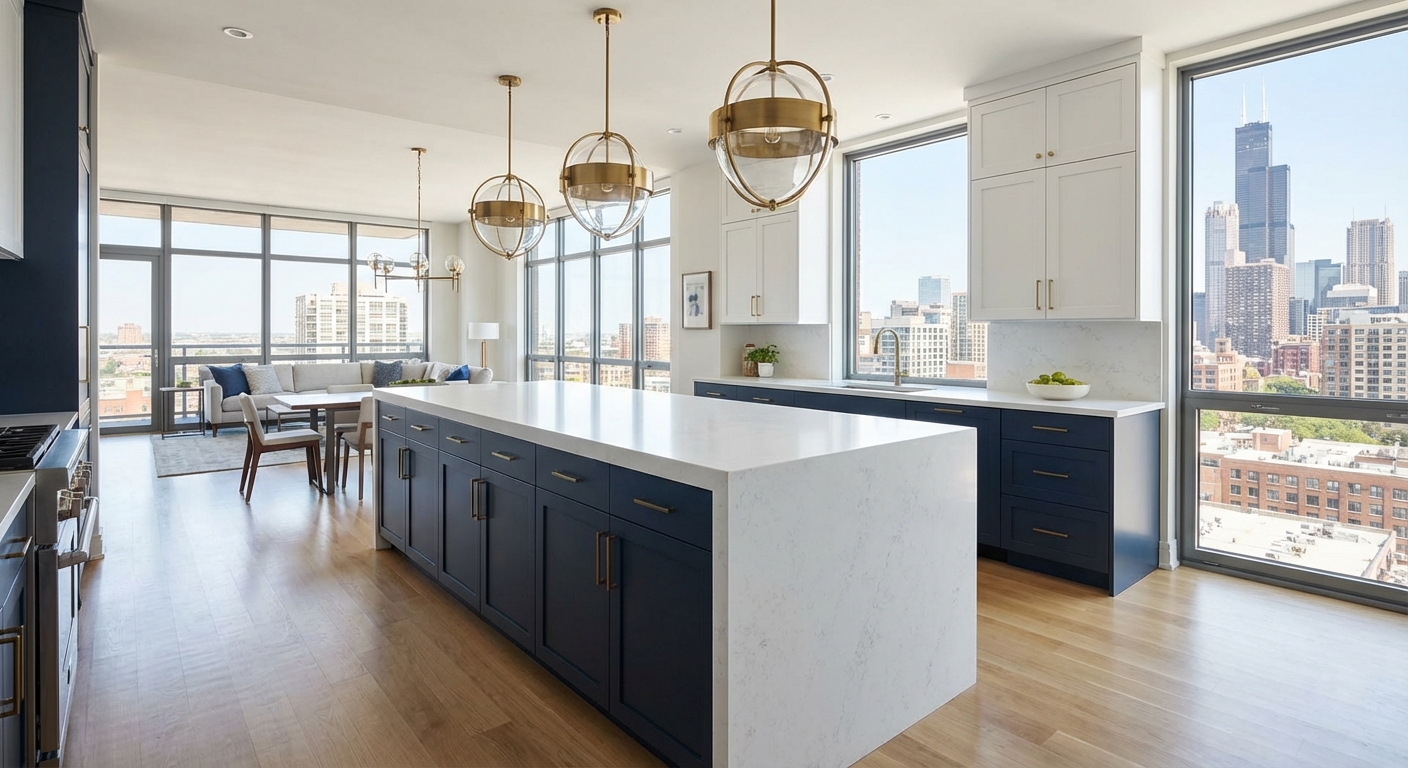
- New-construction condos (post-2010): Hard maple, painted. These units have tight building envelopes and HVAC that keeps humidity relatively stable. Maple's smooth grain paints beautifully and resists the minor humidity fluctuations you'll see.
- Pre-war greystones and bungalows: White oak, stained. These homes breathe — older windows, less insulation, more dramatic seasonal humidity shifts. White oak's closed pores handle this better than any other species.
- Renovated lofts (West Loop, Fulton Market): White oak in a natural or light stain. The industrial aesthetic pairs perfectly with oak's grain, and the open floor plans in these spaces mean higher humidity exposure from cooking without traditional kitchen walls to contain it.
- High-end single-family homes (Lincoln Park, Gold Coast): Cherry with conversion varnish, or white oak depending on design direction. These homes typically have whole-house humidification systems, which gives cherry the stable environment it needs to perform.
Every home is different, and these are generalizations. That's why I always start with an in-home consultation where I assess the specific conditions — I've measured humidity in kitchens that varied by 15 percentage points from the living room just 20 feet away, thanks to cooking, dishwashers, and poor ventilation.
Hardware and Construction: Protecting Your Wood Investment
Choosing the right wood species is only half the equation. The hardware and joinery have to work with the wood's natural movement, not against it. Every cabinet door I build uses Blum CLIP top hinges from Austria, which feature 3-dimensional adjustment — meaning I can re-align doors by ±2mm in any direction after installation to compensate for seasonal wood movement. This is critical in Chicago, where a door that's perfectly aligned in October might need a quarter-turn adjustment by February.
For drawer construction, I use ½-inch Baltic birch plywood with dovetail joints on all solid-wood fronts. Dovetails provide mechanical strength that doesn't rely on glue alone — important because seasonal expansion and contraction stress adhesive bonds over time. Combined with Blum Tandem undermount slides rated for 88 pounds, these drawers handle everything from cast iron skillets to heavy ceramic dishes without sagging.
Our 5-year warranty covers all material and hardware defects, but honestly, the cabinets we build are engineered to last decades. The key is matching the right species to the right conditions, drying it properly, finishing it thoroughly, and hanging it on hardware that adjusts over time. That's the approach we take on every one of our 1,300+ completed projects, and you can see the results in our completed kitchen cabinet projects gallery.
Frequently Asked Questions
Is oak or maple better for kitchen cabinets in Chicago?
It depends on whether you're painting or staining. For stained cabinets, I recommend white oak every time — it handles Chicago's humidity swings better than any other species I work with, and it takes stain evenly. For painted cabinets, hard maple is my go-to because its tight, uniform grain creates a flawless painted surface. Both are excellent choices; the finish determines which wins.
Will cherry cabinets hold up in a humid Chicago kitchen?
Cherry can perform well in Chicago if two conditions are met: the wood is kiln-dried to 6-8% moisture content before fabrication, and the finish is a catalyzed conversion varnish that provides real moisture exclusion. The bigger concern with cherry is its softness (950 Janka) and dramatic color change. I install cherry in homes where the client understands and appreciates these characteristics.
How much do solid wood cabinet doors cost compared to laminate?
For a typical 10x10 Chicago kitchen, solid wood cabinet doors add roughly $3,000-6,000 over high-quality laminate options from manufacturers like EGGER. Our custom kitchen projects start at $15,000, and we offer both solid wood and premium laminate depending on your budget and design goals. I walk through these options in every consultation.
How often do wood cabinets need refinishing in Chicago's climate?
With a proper catalyzed conversion varnish finish, I tell clients to expect 15-20 years before refinishing is needed. The finish may dull slightly in high-use areas around handles, but the moisture barrier remains intact. I've seen 14-year-old cabinets from our shop that still look and perform like new because the original finish was applied correctly.
Can I mix wood species in my kitchen — for example, oak perimeter and maple island?
Absolutely, and I do this frequently. Mixing species creates visual contrast and lets you optimize each material for its location. I often use white oak for perimeter bathroom vanity cabinets and island bases where moisture exposure is higher, and painted maple for upper cabinets where weight and smoothness matter most. The key is choosing complementary tones and being intentional about the design.
Ready to Get Started?
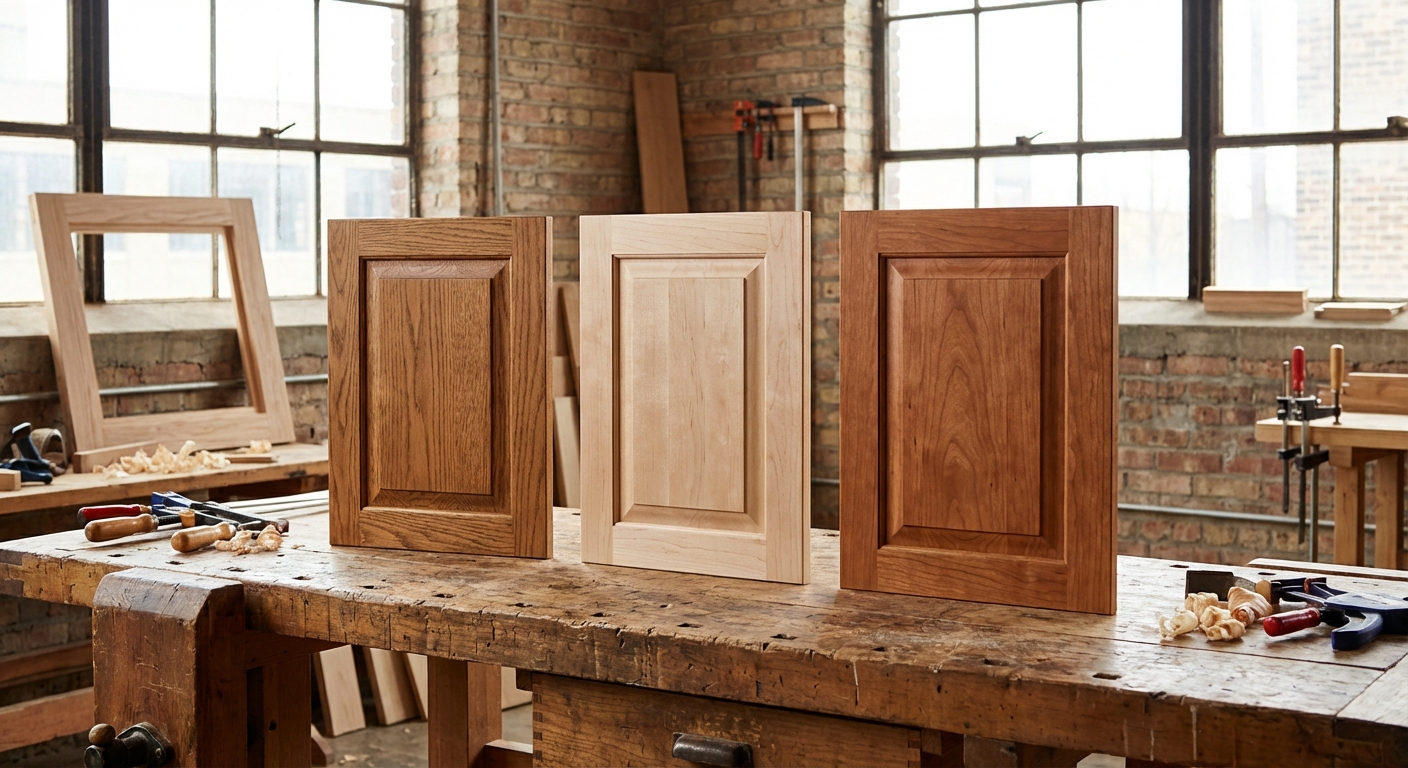
Choosing the right wood species is one of the most important decisions in your kitchen remodel, and it's one I take seriously on every project. If you're building or renovating in Chicago, I'd love to walk you through samples of oak, maple, and cherry in person — seeing and feeling the grain makes the decision real. Reach out to schedule a free kitchen design consultation or call (224) 808-5100. I'll bring the wood samples, the moisture meter, and 14 years of Chicago cabinet-building experience to your kitchen table.