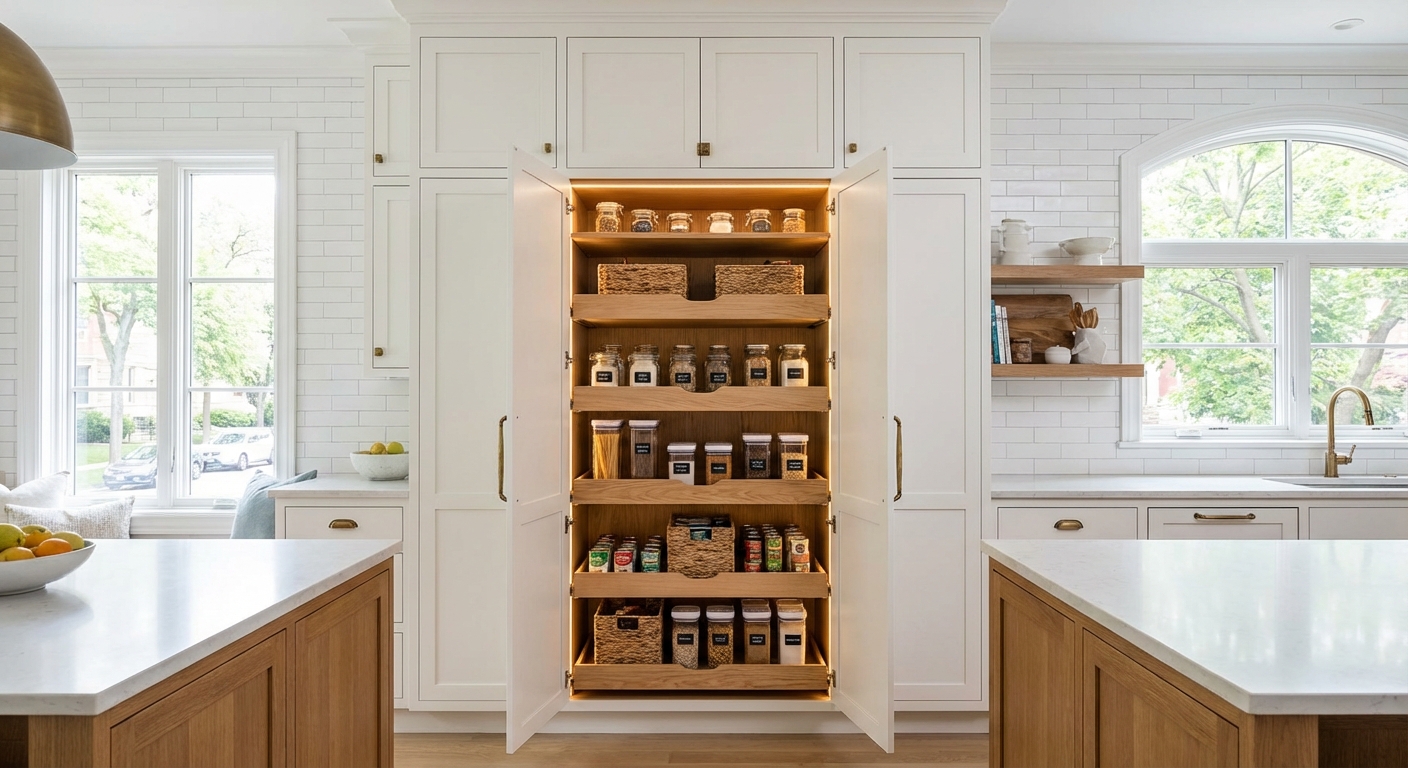
A few weeks ago, I designed a kitchen for a young family in a 1940s Portage Park bungalow where the original layout offered zero dedicated pantry space. They were stacking cereal boxes on top of the refrigerator and storing canned goods in the basement — a common frustration I hear from Chicago homeowners. By carving out a 24-inch-wide tall pantry cabinet next to their fridge and adding pull-out trays, we tripled their accessible food storage without stealing an inch from the cooking zone.
Key Takeaways
- A well-designed pantry cabinet can add 30% to 50% more usable food storage to a typical Chicago kitchen
- Tall pantry cabinets (84 to 96 inches) work best in greystones and bungalows with standard ceiling heights
- Pull-out pantry systems fit into spaces as narrow as 6 inches, perfect for condo galley layouts
- Chicago's seasonal buying habits — Costco runs before winter — demand bulk storage solutions most stock kitchens lack
- Custom pantry cabinets start at roughly $1,200 to $3,500 per unit depending on size and interior fittings
Why Chicago Kitchens Need Smarter Pantry Storage
Living in Chicago means dealing with brutal winters, which turns most of us into pantry hoarders by November. I see it in almost every consultation: homeowners need space for bulk dry goods, canned soups, and enough pasta to survive a polar vortex. The problem is that most Chicago home types — bungalows, greystones, two-flats, and high-rise condos — were built decades before walk-in pantries became a mainstream luxury. Original kitchens in these homes average just 80 to 120 square feet, leaving almost no room for a traditional pantry closet. That is exactly why creative pantry cabinet solutions matter more here than in sprawling suburban floor plans.
Over the past eight years, I have designed pantry storage into more than 600 kitchens across the city. Whether it is a 6-inch pull-out spice pantry squeezed between a dishwasher and a wall in a Lakeview condo or a floor-to-ceiling butler's pantry in a Hinsdale colonial, the goal is always the same: keep every item visible, reachable, and organized. When food storage works, the entire kitchen feels bigger — even if the square footage has not changed at all.
Tall Pantry Cabinets: The Workhorse of Chicago Kitchens
If you have even 18 to 24 inches of available wall space, a tall pantry cabinet is the single most impactful upgrade I recommend. These cabinets run from 84 to 96 inches high and can hold an astonishing amount of food when outfitted with adjustable shelves, pull-out drawers, or swing-out trays. In a recent Roscoe Village two-flat project, I installed a 24-inch-wide, 96-inch-tall pantry with six pull-out trays, and the homeowner told me it replaced two full kitchen base cabinets she had been using for overflow storage. That freed up her lower cabinets for pots, pans, and small appliances — exactly where those items belong.
The visual impact is dramatic too. A tall pantry flanking the refrigerator creates a built-in look that makes even a modest kitchen feel intentionally designed. I typically spec these with Blum TANDEMBOX pull-out hardware for silky-smooth operation and long-term durability — critical when you are pulling out a loaded shelf of canned goods multiple times a day. For more on choosing the right cabinet dimensions for your space, check out our kitchen cabinet dimensions guide.
Pull-Out Pantry Systems for Narrow Spaces
Chicago galley kitchens and condo layouts rarely offer a spare wall for a full-height pantry. That is where narrow pull-out pantry systems shine. I have installed these in gaps as tight as 6 inches wide — essentially a tall, slim shelf on heavy-duty drawer slides that glides out to reveal spices, oils, and condiments on both sides. In a recent project inside a Streeterville high-rise, we tucked a 9-inch pull-out pantry between the oven column and the end panel, adding storage for over 40 spice jars and a dozen bottles of oil and vinegar.
These systems work best when paired with quality hardware rated for the weight they will carry. I always spec slides rated for at least 100 pounds because a fully loaded pull-out can get heavy fast. The key is smooth, full-extension slides so nothing hides in the back. If you are exploring options for maximizing awkward gaps throughout your home, our guide on custom built-ins for awkward spaces covers even more strategies beyond the kitchen.
Need expert advice? Call (224) 808-5100 or schedule a free kitchen design consultation.
Pantry Cabinet Styles That Work in Chicago Homes
Not every pantry cabinet looks the same, and the right style depends on your home type, kitchen layout, and personal aesthetic. Below is a comparison of the most popular pantry cabinet configurations I design for Chicago clients, along with the home types where each works best.
| Pantry Style | Width Required | Estimated Cost | Best Chicago Home Type |
|---|---|---|---|
| Tall single-door pantry | 18–24 inches | $1,200–$2,500 | Bungalows, greystones |
| Tall double-door pantry | 30–36 inches | $2,000–$3,500 | Colonials, larger two-flats |
| Narrow pull-out pantry | 6–12 inches | $800–$1,800 | Condos, galley kitchens |
| Corner pantry with lazy Susan | 36-inch corner | $1,500–$3,000 | L-shaped bungalow kitchens |
| Built-in butler's pantry wall | 48+ inches | $3,500–$7,000+ | Larger homes, gut renovations |
The tall single-door pantry is my go-to recommendation for Chicago bungalows because the standard 8-foot ceilings accommodate a 96-inch cabinet perfectly with minimal filler. In greystones with 9- or 10-foot ceilings, I often stack a shorter upper cabinet on top to capture that extra vertical real estate. For condos where wall space is a luxury, the narrow pull-out is nearly always the answer — it disappears into the layout when closed and delivers surprising capacity when open.
Interior Organization: What Goes Inside Matters Most
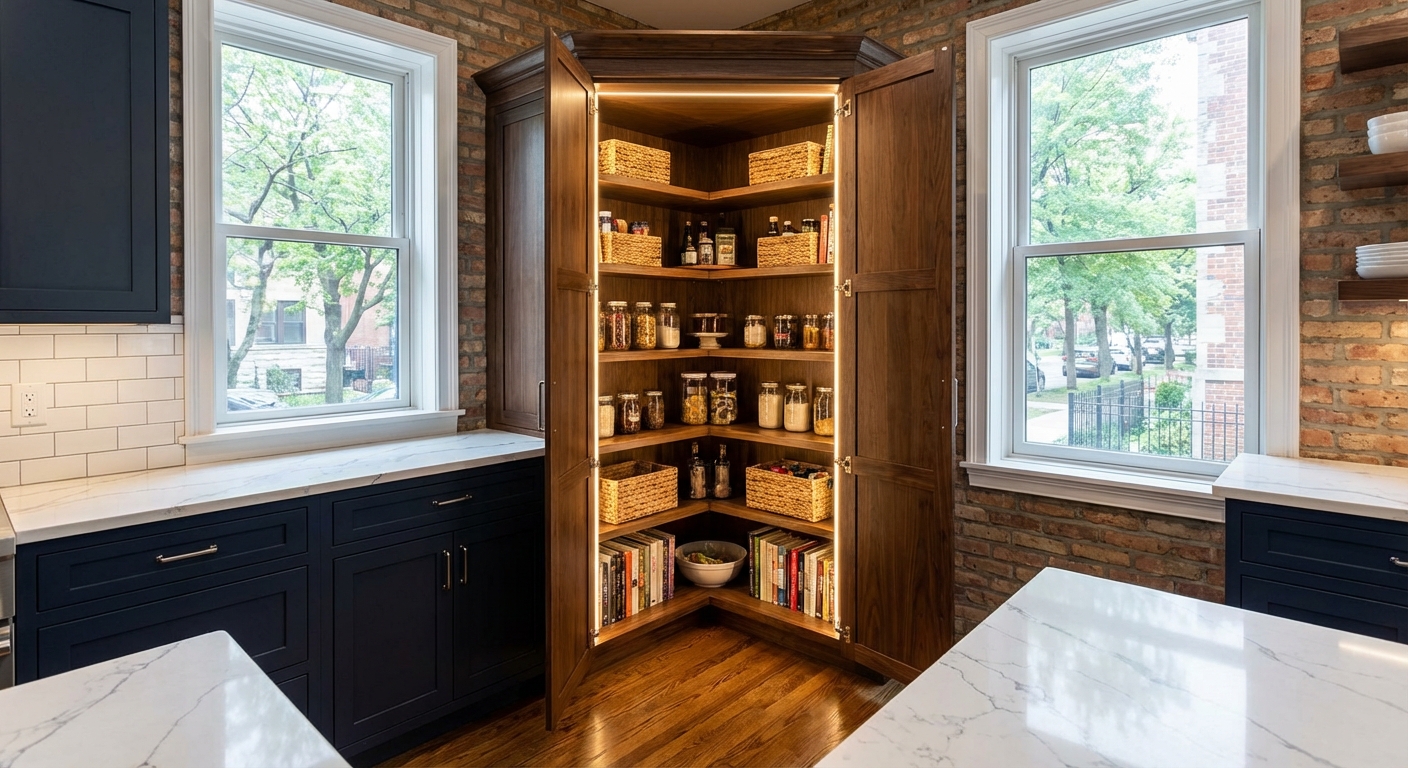
A pantry cabinet is only as good as its interior organization. I have opened brand-new pantry cabinets in client homes that were already a disaster because they relied on fixed shelves spaced too far apart. My rule of thumb is to use adjustable shelves on 32mm system holes so you can reconfigure as your needs change — holiday baking season looks very different from a regular Tuesday. Pull-out drawers at the bottom third of the cabinet prevent you from crouching on the floor to dig for a can of tomatoes buried in the back.
Here are the interior fittings I recommend most often:
- Full-extension pull-out trays — see everything at a glance, rated for 75–100 lbs
- Door-mounted spice racks — use the back of the door for small bottles and packets
- Swing-out shelving units — ideal for deep cabinets where items get lost
- Built-in drawer dividers — keep snack bags, packets, and boxes upright
- Under-shelf baskets — double the usable space on each shelf level
- Interior LED lighting — a must for tall cabinets so you can see the top shelf clearly
At AK Cabinet Craft, our team builds every pantry cabinet with 3/4-inch plywood box construction and Blum CLIP top hinges for soft-close operation. These are not details you notice on day one, but after five years of daily use, the difference between quality hardware and bargain-bin alternatives is enormous. We back every project with a 5-year warranty so our clients never have to worry.
Corner Pantry Solutions for L-Shaped Chicago Kitchens
If your kitchen has an L-shaped layout — extremely common in Chicago bungalows and two-flats — the corner is often wasted or fitted with a basic lazy Susan that wobbles and jams. I prefer converting that corner into a dedicated pantry zone with either a blind-corner pull-out system or a full corner pantry cabinet with internal rotating shelves. In a recent Bucktown bungalow renovation, we installed a 36-inch corner pantry with three rotating trays, and it held more than the homeowner's previous standalone pantry rack that was eating up 6 square feet of floor space in the dining room.
The trick with corner pantries is door clearance. You need to ensure adjacent drawers and appliance doors do not collide when everything is open simultaneously. This is where professional measurement and 3D design modeling saves you from costly mistakes. I always run collision checks in our design software before a single cut is made. Investing in custom kitchen cabinets for Chicago homes means every corner is engineered for your exact layout, not approximated from a stock catalog.
Freestanding vs. Built-In Pantry Cabinets
Some clients ask me about freestanding pantry cabinets — the kind you can buy at a furniture store and slide into place. They have their role, especially for renters, but for homeowners planning to stay in their Chicago home for 5 or more years, built-in pantry cabinets deliver far more value. A built-in pantry is customized to your exact ceiling height, wall width, and storage needs. It looks intentional, increases your home's resale value, and can be finished to match the rest of your cabinetry seamlessly.
Freestanding units typically top out at 72 inches tall and 30 inches wide, leaving gaps above and beside that collect dust and look unfinished. A custom built-in fills every inch from floor to ceiling. According to the National Kitchen and Bath Association, integrated storage solutions consistently rank among the top features that buyers look for in a kitchen. If you are considering cabinetry beyond the kitchen — think hallway linen storage or mudroom cubbies — our team also designs custom cabinets for every room in your home.
Design Trends for Pantry Cabinets in 2026
This year I am seeing several pantry design trends gain momentum across Chicago projects. Fluted or reeded panel doors on tall pantry cabinets add texture and depth that flat slab doors simply cannot match — they look particularly striking in Wicker Park lofts with industrial ceilings. Integrated appliance garages built into pantry walls are another hot request: a section of the pantry with a countertop and an outlet so you can tuck away the stand mixer, toaster, and coffee maker behind closed doors.
Color-wise, deep greens and warm taupes are replacing the all-white kitchens that dominated for the past decade. A 96-inch pantry tower in forest green with brass hardware becomes a statement piece rather than just storage. Two-tone designs — where the pantry is finished in a contrasting color from the main cabinetry — are especially popular in open-concept condos along the lakefront. Our completed projects gallery showcases several recent pantry designs if you want to see these trends in real Chicago kitchens.
- Fluted or reeded pantry doors for textural interest
- Integrated appliance garages hidden behind pantry panels
- Two-tone finishes with the pantry as a contrasting accent
- Glass-front upper sections for displaying curated dry goods in matching containers
- Warm, muted cabinet colors replacing stark white
How We Build Your Pantry Cabinet at AK Cabinet Craft
Our process starts with a free in-home design consultation where I measure your kitchen and discuss your storage habits, cooking style, and aesthetic preferences. From there, I create a 3D rendering so you can see exactly how your new pantry cabinet integrates with the rest of the kitchen before we build a single thing. At AK Cabinet Craft, our team has completed 1,300+ projects across Chicagoland, and we build every cabinet in our own shop with a 21-day production timeline. That means you are not waiting months for overseas shipping — your pantry is designed, built, and installed on a schedule that respects your time.
We use Blum soft-close hardware from Austria, 3/4-inch plywood construction, and premium EGGER laminates for durable, beautiful finishes. Every project comes with our 5-year warranty. Complete kitchen projects — including pantry cabinets — start from $15,000, but standalone pantry units can be quoted individually depending on size and complexity. Browse our ready-made kitchen design lines if you want a head start on choosing a style before your consultation.
Frequently Asked Questions
How wide does a pantry cabinet need to be to be useful?
I have designed effective pantry pull-outs as narrow as 6 inches. Even at that width, you can store spices, oils, and small condiments on both sides of a pull-out tray. For a full pantry experience with adjustable shelves and pull-out drawers, I recommend at least 18 to 24 inches of width.
Can I add a pantry cabinet to my kitchen without a full renovation?
Absolutely. If you have an unused wall section, a gap beside the refrigerator, or even a closet adjacent to the kitchen, I can design a standalone pantry unit that matches your existing cabinetry. It is one of the most cost-effective upgrades I do — typically $1,200 to $3,500 depending on the size and interior fittings.
What is the best interior setup for a tall pantry cabinet?
I recommend pull-out trays on the bottom third for heavy items like canned goods, adjustable shelves in the middle third for boxes and bags, and fixed or adjustable shelves up top for less frequently used items. Door-mounted racks and interior LED lighting round out the setup and make everything instantly visible.
Do pantry cabinets increase home resale value in Chicago?
In my experience, yes. Organized, built-in food storage is one of the first things buyers notice during kitchen walk-throughs. A well-designed pantry signals that the kitchen was thoughtfully planned, which translates to perceived value — especially in competitive neighborhoods like Lincoln Park, Bucktown, and Lakeview.
How long does it take to get a custom pantry cabinet installed?
At AK Cabinet Craft, our production time is 21 days from design approval. Installation of a single pantry unit typically takes 2 to 4 hours. If the pantry is part of a larger kitchen project, it is installed along with the rest of the cabinetry in a single coordinated visit.
Ready to Get Started?
If you are tired of digging through cluttered cabinets or stacking groceries on top of the fridge, a custom pantry cabinet can transform the way your kitchen works. I would love to visit your home, measure your space, and show you exactly what is possible — whether you live in a cozy Portage Park bungalow or a sleek South Loop condo. Schedule a free kitchen design consultation or call (224) 808-5100 to get started today.