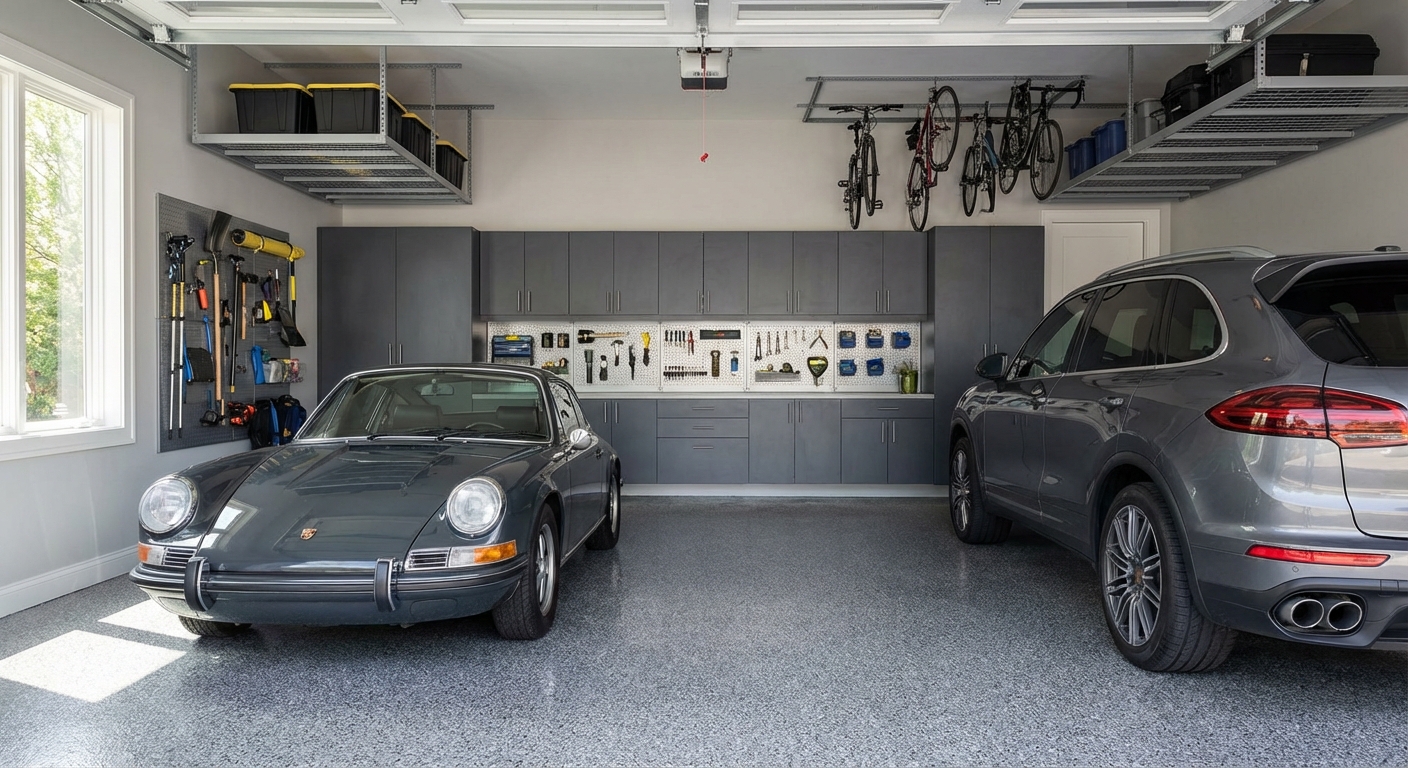
A few weeks ago I visited a couple in Roscoe Village who had a detached single-car garage that doubled as a workshop, winter gear dump, and kid-bike parking lot. They could barely open their car doors without knocking into a pile of snow shovels and camping equipment. After measuring, I found they had over 90 square feet of usable wall space that was completely wasted — and that's when we started planning a garage cabinet system that would give them their garage (and their sanity) back.
Key Takeaways
- Chicago garages face temperature swings of over 100°F annually — material selection is critical for cabinets that last.
- Wall-mounted cabinet systems free up 100% of your floor space for parking and workspace.
- Zone-based organization (tools, sports, seasonal, automotive) eliminates the "pile everything in the corner" problem.
- Custom garage cabinets typically cost between $4,000 and $12,000 depending on size and configuration.
- At AK Cabinet Craft, our team builds garage systems with the same 5-year warranty and Austrian hardware we use in kitchens and closets.
Why Chicago Garages Need a Different Approach
I've worked on 400+ storage projects across the city, and Chicago garages present challenges you won't find in a design magazine from Arizona. Our winters bring road salt, moisture, and subzero temperatures that destroy cheap particleboard in a single season. Then summer hits with 90°F+ heat and humidity that warps anything not properly sealed. A standard closet system from a big-box store simply won't survive this kind of punishment.
Most Chicago homes — especially bungalows, two-flats, and vintage greystones — have garages that are undersized by modern standards. A typical single-car detached garage in Lincoln Square or Ravenswood measures roughly 10 by 20 feet, and that's if you're lucky. You need cabinets specifically designed for these dimensions, not off-the-shelf units that assume you have a three-car suburban spread. That's where custom design makes a real difference — every cabinet fits the wall it's built for, not the other way around.
Chicago garages also serve triple or quadruple duty. They store bikes, strollers, holiday decorations, lawn equipment, tools, and winter supplies all at once. A well-designed cabinet system accounts for all of these categories and gives each one a dedicated zone, so your snow blower isn't buried behind the patio furniture in January.
Material Choices That Survive Chicago Winters
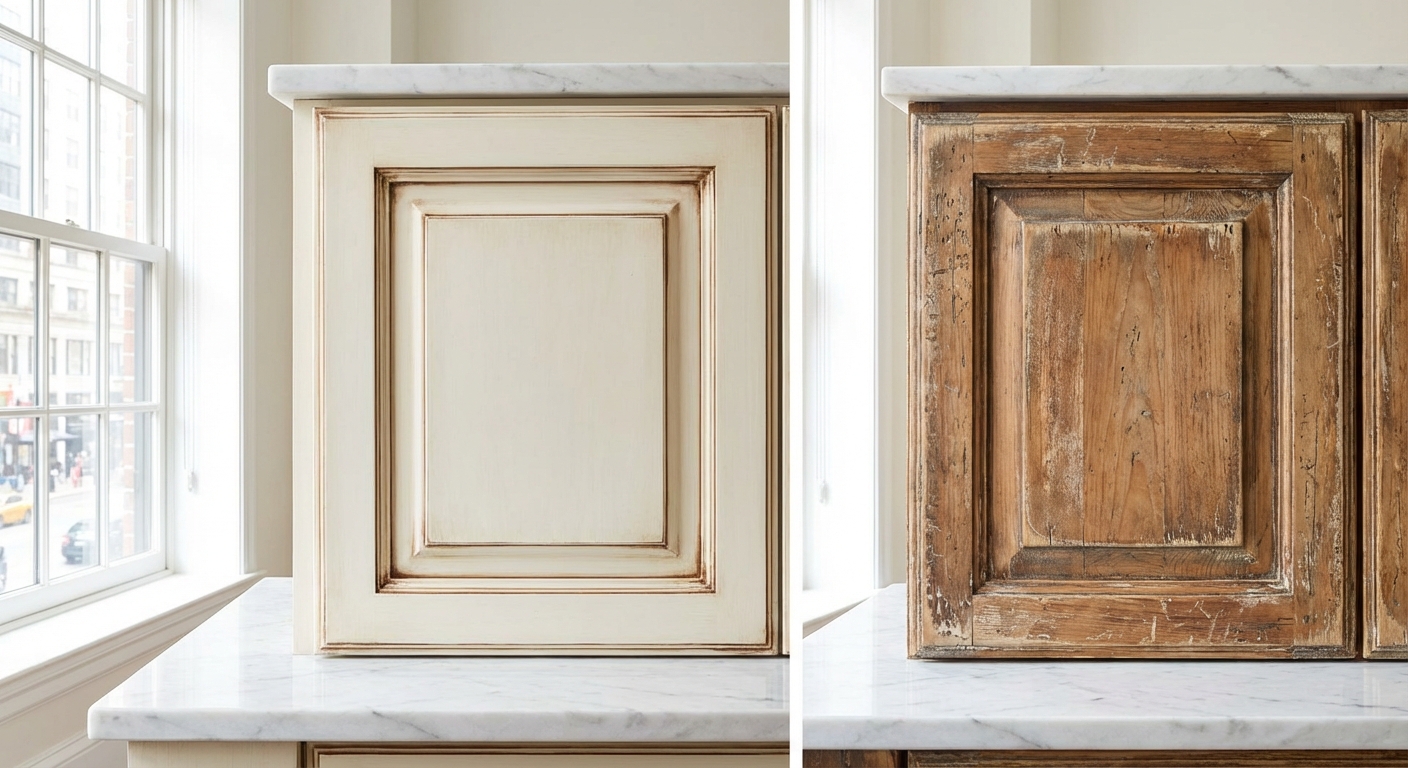
Not all cabinet materials belong in a garage, and this is the single biggest mistake I see homeowners make. Standard MDF swells and crumbles when exposed to the moisture fluctuations in an unheated Chicago garage. I recommend moisture-resistant melamine or high-pressure laminate from manufacturers like EGGER, which are engineered for exactly these conditions. Plywood-core construction is another solid option that handles temperature swings far better than particleboard alternatives.
Hardware matters just as much as the box itself. I spec Blum soft-close hinges and drawer runners for garage cabinets because they're rated for tens of thousands of cycles and resist corrosion from moisture and salt exposure. Cheap hinges seize up after one winter; quality hardware keeps working for years. For the cabinet exterior, a sealed thermofoil or painted finish provides an extra moisture barrier that raw wood edges simply can't match.
| Material | Moisture Resistance | Temperature Tolerance | Best For |
|---|---|---|---|
| High-Pressure Laminate (HPL) | Excellent | Excellent | All garage zones |
| Moisture-Resistant Melamine | Very Good | Good | Upper cabinets, dry zones |
| Plywood Core (sealed) | Good | Excellent | Heavy-duty workbenches |
| Standard MDF | Poor | Fair | Not recommended for garages |
| Metal/Steel | Excellent | Excellent | Industrial look, heavy loads |
Zone-Based Organization: The System That Actually Works
Every successful garage project I design starts with zones — not cabinets. Before I measure a single wall, I ask the homeowner to list every category of item their garage needs to hold. Then we assign each category a specific zone, and the cabinet configuration flows from there. This approach prevents the common problem of building beautiful cabinets that don't actually fit your life.
For most Chicago families, I see four to six zones repeat themselves: a tool and workshop zone, a sports and recreation zone, a seasonal storage zone (holiday décor, winter gear), an automotive zone (fluids, cleaning supplies), a lawn and garden zone, and sometimes a kids' zone for bikes and outdoor toys. Each zone gets a different cabinet configuration — the tool zone might need a pegboard panel flanked by tall cabinets with adjustable shelving, while the seasonal zone works best with deep overhead cabinets accessible by step stool a few times a year.
- Tool Zone: Workbench with pull-out drawers, wall-mounted upper cabinets, slatwall panel for frequently used hand tools
- Sports Zone: Open cubbies for helmets and balls, hooks for bikes, tall cabinet for ski equipment
- Seasonal Zone: Overhead ceiling-mounted cabinets or high wall cabinets with labeled bins
- Automotive Zone: Lockable lower cabinet for chemicals, paper towel holder, small shelf for fluids
- Lawn and Garden Zone: Tall narrow cabinet with vertical dividers for rakes and shovels, shelf for smaller supplies
This is the same zone-based philosophy I use when designing custom closets and wardrobe systems — give everything a home, and clutter simply can't accumulate. The principle scales perfectly from a bedroom closet to a two-car garage.
Need expert advice? Call (224) 808-5100 or schedule a free garage storage design consultation.
Wall-Mounted vs. Floor-Standing Garage Cabinets
This is one of the first decisions I walk clients through, and the right answer depends on your garage's specific conditions. Wall-mounted cabinets are my go-to recommendation for most Chicago garages because they keep everything at least 6 to 8 inches off the floor. That gap is critical — it protects your belongings from spring snowmelt puddles, makes sweeping and hosing out the garage effortless, and gives you visible floor space that makes the garage feel larger than it is.
Floor-standing cabinets make sense when you need a heavy-duty workbench surface or when the garage walls can't support significant weight (which I occasionally see in older brick garages with deteriorating mortar). A hybrid approach — floor-standing base cabinets under a workbench plus wall-mounted uppers everywhere else — gives you the best of both worlds. I've used this combination on dozens of projects in neighborhoods like Bucktown and Wicker Park where the garages are small but the homeowners need serious workspace.
Weight capacity is a real engineering consideration, not just a sales pitch. A 36-inch wall-mounted cabinet loaded with tools and hardware can easily weigh 150 to 200 pounds. I always specify heavy-duty French cleat mounting systems anchored into studs or masonry, and I verify wall conditions during the initial site visit. This is one area where a professional installation makes all the difference between cabinets that stay put for decades and cabinets that rip out of the wall the first time you load them up.
Smart Add-Ons That Chicago Homeowners Love
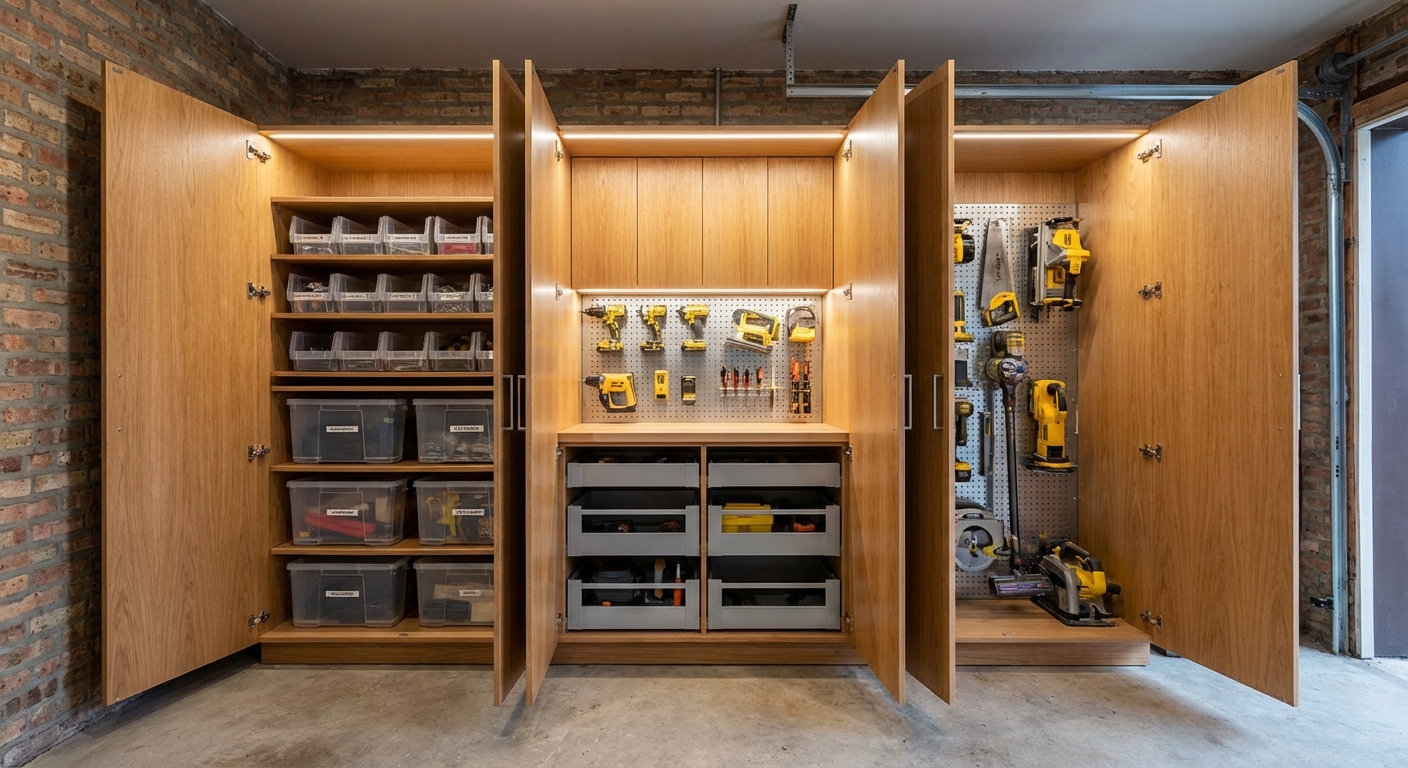
Beyond basic cabinets, a few upgrades consistently deliver outsized value in garage projects. Slatwall panels — those grooved wall panels that accept interchangeable hooks and bins — are incredibly versatile for the spaces between cabinets. I install them in almost every garage project because they let you rearrange your tool and equipment storage without drilling new holes every time your needs change. A 4-by-8-foot slatwall panel typically runs $150 to $300 installed, which is a small investment for that kind of flexibility.
Overhead ceiling storage is another game-changer, especially in garages with 9-foot or taller ceilings. These platform-style racks mount to ceiling joists and hold up to 600 pounds of seasonal bins, luggage, and camping gear. They reclaim dead airspace that you'd never use otherwise. Pull-down attic-style ladders can pair with these for easier access, though most homeowners are fine with a sturdy step ladder a few times a year.
- LED under-cabinet lighting: Essential for workbench zones, runs $100 to $250 per run
- Charging station cabinet: Dedicated drawer with built-in power strip for cordless tool batteries
- Fold-down workbench: Wall-mounted surface that folds flat when you need parking space
- Lockable cabinets: Critical if you store chemicals, power tools, or firearms
- Boot and coat hooks: Near the entry door for wet winter gear — keeps salt off the house floors
These add-ons are similar to the details I incorporate in custom built-in solutions for awkward spaces — it's the small, thoughtful touches that turn a basic storage system into something that genuinely improves your daily routine.
Garage Cabinet Ideas by Chicago Home Type
Chicago's housing stock is incredibly diverse, and garage configurations vary just as widely. A detached single-car garage behind a bungalow in Jefferson Park needs a completely different approach than a tandem two-car garage under a Lincoln Park townhome. I've worked on both — and everything in between — so here's what I've learned about matching the system to the structure.
| Home Type | Typical Garage Size | Best Cabinet Strategy | Estimated Budget |
|---|---|---|---|
| Bungalow (detached single-car) | 10' × 20' | Wall-mounted on 3 walls + overhead | $4,000–$7,000 |
| Two-flat (shared or rear garage) | 12' × 20' | One long wall system + slatwall | $3,500–$6,000 |
| Greystone (narrow lot garage) | 9' × 18' | Compact vertical storage, fold-down bench | $3,000–$5,500 |
| Townhome (attached two-car) | 20' × 22' | Full zone system, workbench island option | $8,000–$12,000 |
| New-construction condo (indoor) | 9' × 18' per space | Slim wall cabinets, ceiling racks | $3,000–$5,000 |
For the narrow-lot garages common in neighborhoods like Pilsen and Bridgeport, I often design 12-inch-deep upper cabinets that don't steal parking clearance but still hold an impressive amount of gear. Vertical pull-out pantry-style cabinets work beautifully for shovels, rakes, and brooms in these tight spaces. The same principles I apply when designing custom cabinets for any room hold true in the garage — precise measurements and custom sizing beat off-the-shelf compromises every time.
The Design and Installation Process
At AK Cabinet Craft, our team has completed 1,300+ projects, and the garage cabinet process follows a proven sequence. It starts with an in-home consultation where I measure every wall, note ceiling height, identify electrical outlets and obstructions, and — most importantly — have a real conversation about how you use the space. This visit takes about 45 minutes to an hour and is completely free.
From there, I create a 3D design that maps every cabinet, shelf, and accessory to your specific garage dimensions. You'll see exactly what the finished product looks like before we order a single sheet of material. Once you approve the design, our shop produces your cabinets within our standard 21-day production timeline. Installation typically takes 1 to 2 days depending on the project scope, and we handle everything from wall prep to final adjustment.
Every garage cabinet system we build comes with our 5-year warranty covering materials and workmanship. That warranty exists because we use the same quality construction and Blum Austrian hardware in a garage system that we use in a high-end kitchen — because your garage deserves to work just as hard as the rest of your home.
If you're also considering updating storage inside the house, many clients bundle their garage project with a custom bathroom vanity or closet system to streamline design and installation. Bundling often saves on overall project costs since we're already on-site and custom-building for your home.
Frequently Asked Questions
Will garage cabinets survive a Chicago winter in an unheated garage?
Absolutely — if you choose the right materials. I always spec moisture-resistant melamine or high-pressure laminate for garage projects specifically because they handle freeze-thaw cycles and humidity swings without warping or delaminating. Standard MDF is the one material I refuse to use in an unheated garage because it will fail within a year or two.
How much do custom garage cabinets cost in Chicago?
Most of my garage projects fall between $3,000 and $12,000, with the typical single-car garage system landing around $5,000 to $7,000. The final price depends on how many linear feet of cabinetry you need, whether you want a workbench, and which add-ons like slatwall or overhead racks you include. I provide a detailed quote after the initial site visit so there are no surprises.
How long does a garage cabinet project take from start to finish?
From approved design to completed installation, you're looking at roughly 3 to 4 weeks. Our production team works within a 21-day build cycle, and installation is usually done in 1 to 2 days. The design and approval phase before that depends on how quickly we finalize your layout — most clients are ready within a week.
Can I add to my garage cabinet system later?
Yes, and I actually plan for this. I design systems with standardized mounting rails and consistent dimensions so you can add cabinets, shelves, or slatwall sections down the road without starting from scratch. The finishes we use are catalog-based, so matching new pieces to your existing system years later is straightforward.
Do you handle electrical work for garage lighting or outlets?
I coordinate with licensed electricians regularly for garage projects that need under-cabinet lighting or additional outlets near a workbench. I include outlet and light placement in my design plans so the electrician knows exactly where everything goes before cabinets are installed. This ensures a clean, professional result with no visible wiring.
Ready to Get Started?
If your Chicago garage has become the room where everything goes to disappear, I'd love to help you take it back. A well-designed garage cabinet system doesn't just organize your stuff — it gives you usable square footage you forgot you had. At AK Cabinet Craft, our team builds garage storage with the same precision and quality materials we bring to every kitchen, closet, and vanity project across the city. Schedule a free garage storage design consultation or call (224) 808-5100 — I'll come measure your space, talk through your needs, and show you what's possible.