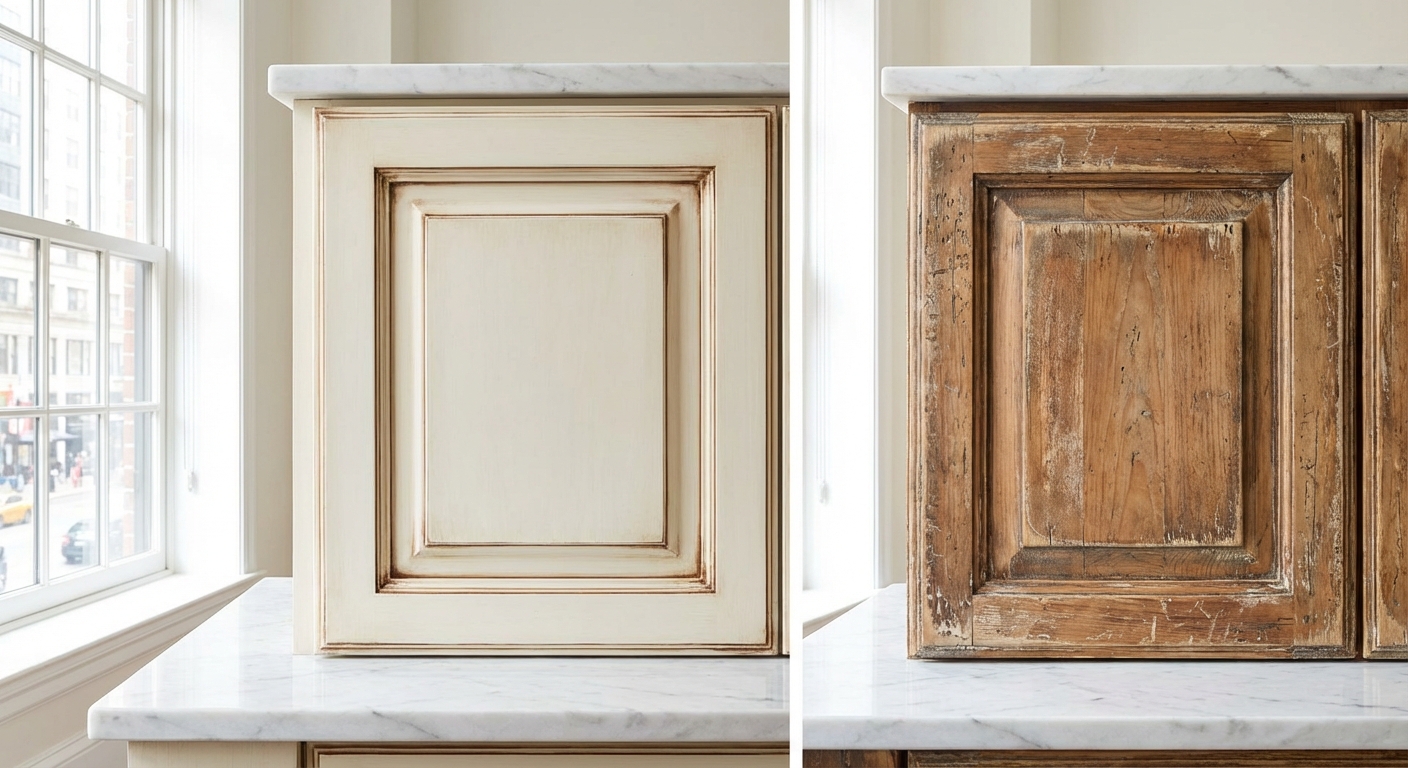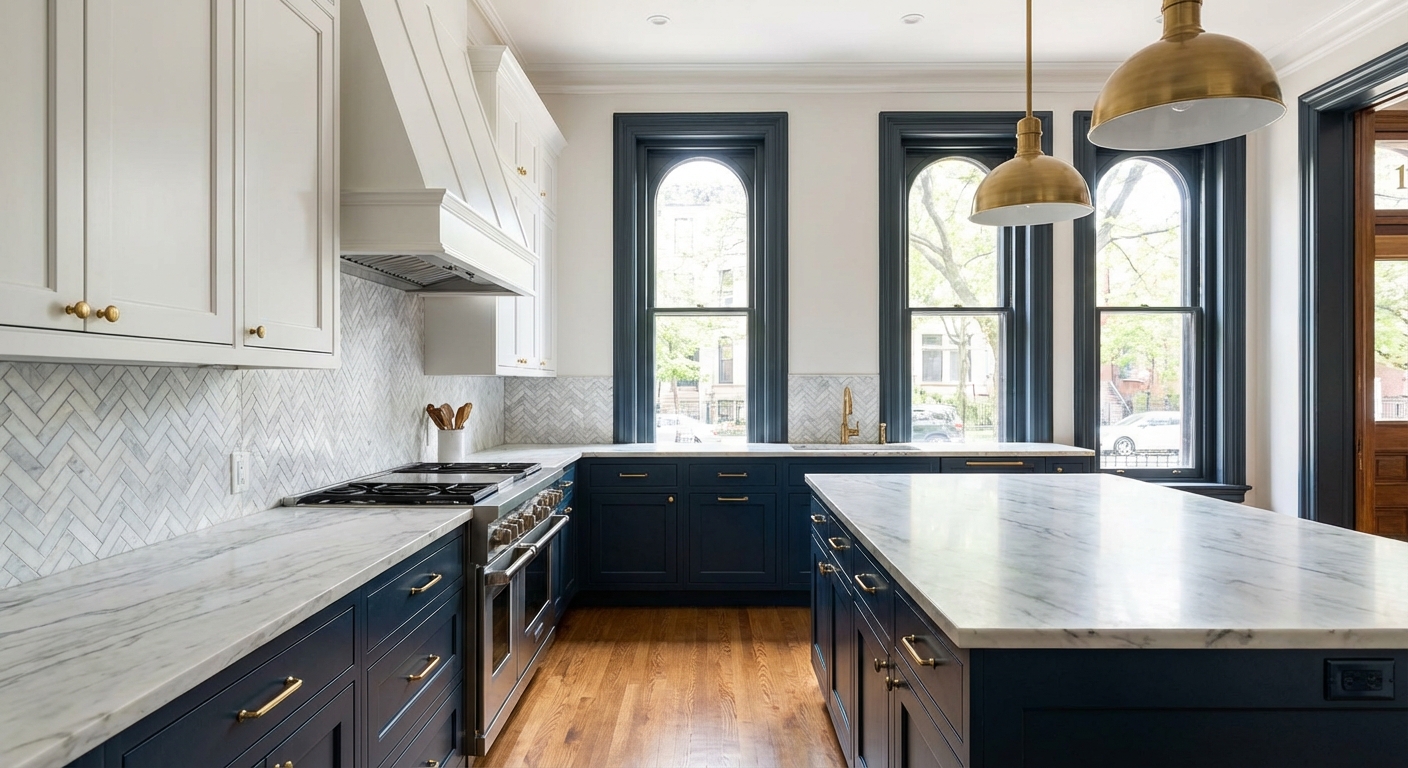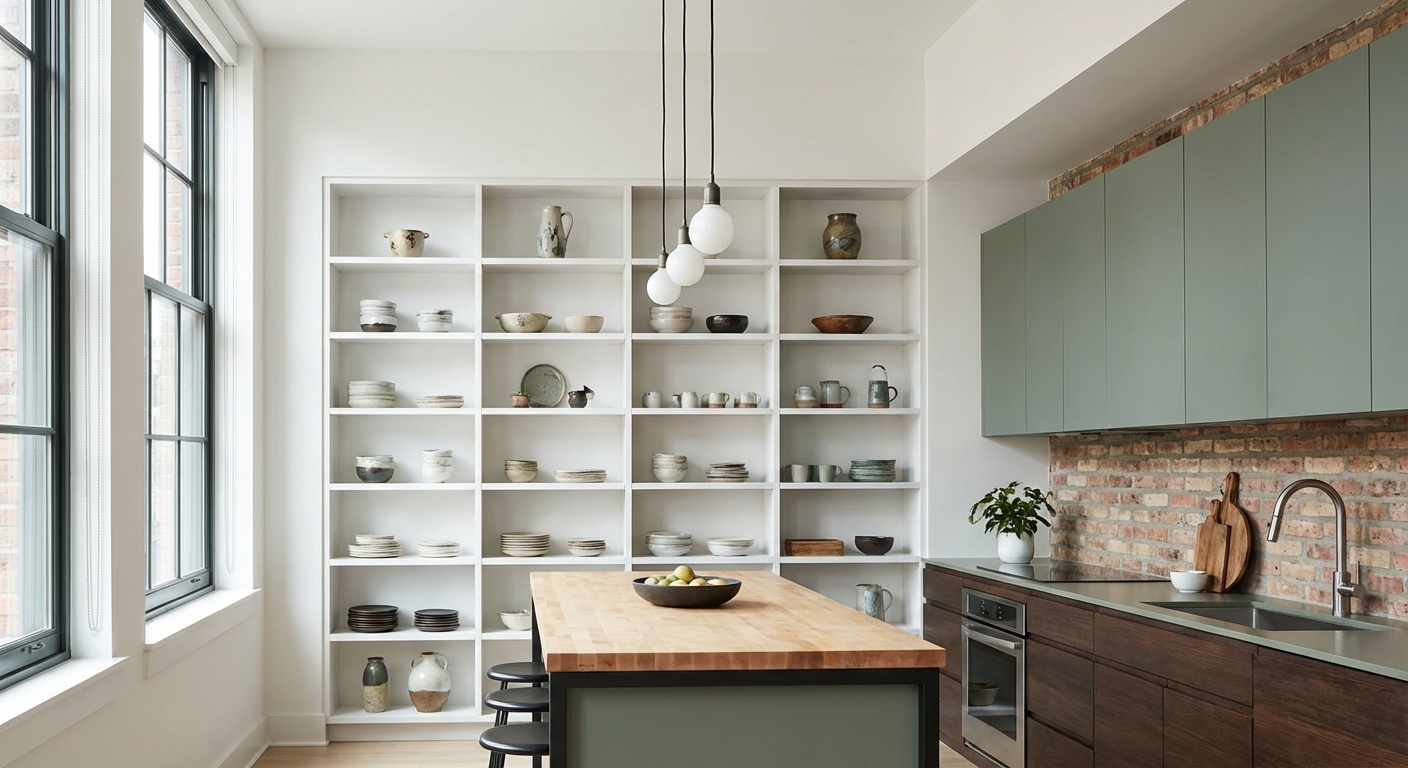
Two months ago, a couple in a 1940s Ravenswood greystone asked me to rip out every upper cabinet in their kitchen and replace them with floating shelves. They'd seen the look on Instagram and wanted that airy, gallery-like feel. I walked them through the trade-offs — the Chicago dust, the Lake Michigan humidity swings, the cooking grease that settles on every exposed surface — and by the end of our conversation, we landed on a hybrid design that gave them the aesthetic they loved without sacrificing 40% of their storage. That project perfectly illustrates why the open shelving vs upper cabinets debate in Chicago kitchens is never as simple as picking a style you like online.
Key Takeaways
- Open shelving costs 30-50% less to install than upper cabinets but demands constant maintenance in Chicago's dusty, humid climate.
- Upper cabinets provide 40-60% more usable storage per linear foot than open shelves.
- A hybrid approach — combining both — is the most popular choice in 65% of our 2025-2026 Chicago kitchen projects.
- Blum lift-system hardware makes modern upper cabinets far more accessible than outdated swing-door models.
- Material selection matters more in Chicago than almost any other city due to seasonal humidity shifts of 25-70% RH.
Why This Debate Matters More in Chicago
I started building cabinets in my grandfather's woodshop 14 years ago, and one lesson he drilled into me early was that climate dictates design. Chicago is not Los Angeles. Our kitchens endure brutal temperature swings — from -10°F winter mornings with the furnace blasting dry heat to 95°F summer days with relative humidity above 65%. That cycle puts enormous stress on every surface in your kitchen. Open shelving leaves dishes, glasses, and pantry items completely exposed to those conditions, while enclosed upper cabinets create a micro-environment that buffers against dust, grease, and moisture fluctuation.
Beyond climate, Chicago's housing stock creates unique constraints. Pre-war greystones, two-flats, and bungalows often have kitchens under 120 square feet. Ceiling heights range from 8 feet in postwar condos to 10+ feet in vintage Victorians. Those dimensions determine how much vertical storage you can realistically access. I've worked on over 200 kitchen projects in the last three years where the ceiling height alone ruled out one option or the other. If you're working with a compact layout, our kitchen cabinet dimensions guide breaks down exactly how to maximize every inch.
Neighborhood also plays a role. Clients near the L tracks in Wicker Park or Logan Square deal with noticeably more airborne particulate than those in quieter pockets of Lincoln Park. I've seen open shelving near train lines collect a visible film of grime within 48 hours of cleaning. That's not a dealbreaker for everyone, but it's a reality I make sure every client understands before we start cutting wood.
Open Shelving: The Honest Pros and Cons
Let me be clear — I'm not anti-open shelving. I've installed beautiful floating shelf systems in dozens of Chicago kitchens, and when they're done right, the result is stunning. Open shelving opens up sightlines, makes a small kitchen feel larger, and lets you display items that bring personality to a room. Solid walnut shelves on a white subway tile backsplash in a Lincoln Square bungalow? That's a showstopper. The cost advantage is real, too. A 10-linear-foot run of quality floating shelves in 1.5-inch thick hardwood runs about $1,200 to $2,500 installed, compared to $3,500 to $6,000 for the same run in custom upper cabinets.
But here's what the design blogs won't tell you. Open shelving requires curation — constant, ongoing curation. Every item is on display, which means mismatched mugs, cereal boxes, and that one chipped plate you refuse to throw away all become part of your "design." Practically, I tell clients that open shelving works best when you limit it to one wall or a 4-6 foot section dedicated to items you genuinely want to see every day: matching dishware, cookbooks, a few plants.
- Pro: Lower upfront cost — 30-50% less than custom uppers
- Pro: Creates visual openness, especially in kitchens under 100 sq ft
- Pro: Easy access — no doors to open
- Con: Dust and grease accumulate rapidly in Chicago's climate
- Con: Reduces usable storage by 40-60% vs. enclosed cabinets
- Con: Requires disciplined organization and frequent cleaning
- Con: Wood shelves can warp in humidity swings without proper sealing
Upper Cabinets: What Modern Options Actually Look Like
When most people picture upper cabinets, they think of boxy, dark-stained oak doors from the 1990s. That's not what we're building at AK Cabinet Craft in 2026. Today's uppers feature 3/4-inch Baltic birch plywood boxes, frameless European construction, and hardware from Blum that transforms how doors and shelves move. The AVENTOS HK-TOP lift system, for example, lets a tall cabinet door swing up and hold in place so you never bang your head reaching for a mixing bowl. Soft-close hinges from the CLIP top BLUMOTION line mean zero slamming — ever.
Storage capacity is where uppers dominate. A standard 30-inch wide by 36-inch tall upper cabinet with two adjustable shelves holds the equivalent of what you'd need three open shelves to display, and everything stays protected. For narrow Chicago kitchens, I often spec 42-inch tall uppers that reach closer to the ceiling, adding a full extra shelf. That alone can add 6-8 cubic feet of storage per wall — enough to eliminate countertop clutter entirely.
The aesthetic argument against upper cabinets has weakened dramatically. Slab-front doors in matte lacquer, textured EGGER laminate with woodgrain or concrete finishes, glass-insert panels with interior LED lighting — these options make uppers look sleek, not heavy. I regularly install 18mm EGGER melamine interiors with 0.8mm PVC edgebanding that handles Chicago's humidity without delaminating, backed by our 5-year warranty.
Need expert advice? Call (224) 808-5100 or schedule a free kitchen design consultation.
Side-by-Side Comparison: Open Shelving vs Upper Cabinets
I put together this comparison table based on actual data from our Chicago projects. These aren't theoretical numbers — they come from 1,300+ completed installations our team has delivered across the city. Every figure reflects real-world performance in Chicago's climate conditions.
| Factor | Open Shelving | Upper Cabinets |
|---|---|---|
| Cost per linear foot (installed) | $120–$250 | $350–$600 |
| Storage capacity per linear foot | ~1.5 cu ft | ~3.5 cu ft |
| Dust/grease protection | None | Full enclosure |
| Cleaning frequency (Chicago average) | Weekly | Monthly exterior wipe |
| Humidity resistance | Moderate (if sealed) | High (enclosed micro-climate) |
| Visual weight in small kitchens | Light and airy | Can feel heavy if poorly designed |
| Lifespan in Chicago conditions | 8–12 years (wood shelves) | 15–25 years (quality plywood/laminate) |
| Installation timeline | 1–2 days | 2–4 days |
| Resale value impact | Neutral to slightly negative | Positive — buyers expect storage |
One detail that surprises most clients: the resale value line. Real estate agents I work with in Lincoln Park, Lakeview, and Bucktown consistently say buyers penalize kitchens that lack upper storage. Open shelving photographs beautifully for listings, but during walkthroughs, the first question buyers ask is "where do I put everything?" If resale is part of your calculus, uppers almost always win.

The Hybrid Approach: Why Most Chicago Homeowners Choose Both
Here's what I've seen in our shop over the last two years: roughly 65% of our kitchen clients choose a hybrid layout — upper cabinets on the primary storage walls, with a targeted section of open shelving as an accent. This approach captures the visual lightness of open shelves without gutting your storage capacity. It's not a compromise; it's strategic design. I typically recommend open shelving flanking a window, above a coffee station, or on a short wall where you'd otherwise install a single narrow cabinet that's awkward to access anyway.
For that Ravenswood greystone project I mentioned earlier, we installed 16 linear feet of custom kitchen cabinets along the main cooking wall, using 42-inch tall frameless uppers in a flat-panel Fenix NTM finish. On the adjacent wall near the breakfast nook, we mounted 6 feet of floating walnut shelves with concealed steel brackets rated for 75 lbs each. The walnut got three coats of conversion varnish to handle humidity. The final result gave them 22 cubic feet of enclosed storage plus a beautiful display area for their ceramic collection — and the total came in at $18,400 for all cabinetry, well within their budget.
A hybrid layout also lets you play with depth. Upper cabinets are typically 12 inches deep, while floating shelves can be as shallow as 8 inches. That 4-inch difference creates a visual step-back that makes the shelving section feel recessed and intentional. It's a small detail, but in a kitchen under 100 square feet, those proportions matter enormously. If your home has awkward nooks or uneven walls — common in Chicago's older housing stock — our team covers creative solutions in our guide to custom built-ins for awkward spaces.
Material Selection for Chicago's Climate
Whether you go with shelves, cabinets, or a hybrid, material choice is the single biggest factor in how long your investment lasts in Chicago. For open shelving, I recommend kiln-dried hardwoods — walnut, white oak, or hard maple — at a minimum thickness of 1.5 inches. Anything thinner will bow under load within 2-3 years, especially during summer humidity spikes. Every shelf needs a catalyzed finish; standard polyurethane won't hold up to the moisture cycles we see from November through March when furnaces dry indoor air down to 20% RH or below.
For upper cabinet boxes, I use 3/4-inch (18mm) furniture-grade plywood exclusively. At AK Cabinet Craft, we don't build boxes from particleboard or MDF — both absorb moisture and swell at the joints within a few Chicago winters. Door fronts can be plywood, MDF with lacquer (acceptable in a controlled indoor environment), or EGGER thermally fused laminate. I'm a big fan of EGGER's ST28 Feelwood texture for clients who want a wood look without worrying about refinishing every five years.
- Plywood boxes: Best moisture resistance, holds screws for decades
- EGGER TFL doors: Scratch-resistant, zero off-gassing, consistent color
- Solid wood shelf material: Must be sealed properly — catalyzed varnish or conversion finish
- Avoid for Chicago: Raw pine shelves, thermofoil doors (peel in humidity), particleboard cores
Hardware is the other half of the equation. Every upper cabinet we build ships with Blum hinges and drawer systems — I'm a certified Blum specialist and I've tested enough off-brand alternatives to know the difference. Blum's CLIP top hinges are rated for 200,000+ cycles, which translates to roughly 50 years of daily use. For open shelving brackets, I source 1/4-inch steel L-brackets with a powder-coat finish that won't rust — Chicago's lake-effect moisture corrodes cheap hardware faster than most people expect.
Cost Breakdown: What to Budget in 2026
Let me give you real numbers based on what we're quoting in early 2026. These assume a typical Chicago kitchen with 15-20 linear feet of upper wall space. Material costs have stabilized after the supply chain disruptions of previous years, and labor rates in Chicago reflect our local market. At AK Cabinet Craft, full custom cabinet projects start from $15,000 for a complete kitchen, and our 21-day production timeline keeps your renovation on schedule.
| Scenario | Estimated Cost | Storage Capacity | Maintenance Level |
|---|---|---|---|
| All open shelving (15 LF) | $1,800–$3,750 | ~22 cu ft | High — weekly cleaning |
| All upper cabinets (15 LF) | $5,250–$9,000 | ~52 cu ft | Low — monthly wipe |
| Hybrid (10 LF cabinets + 5 LF shelving) | $4,100–$7,250 | ~42 cu ft | Moderate |
One thing I always tell clients: don't let upfront cost alone drive this decision. The $3,000-$5,000 premium for uppers over open shelving pays for itself in longevity, storage, and resale value. According to the NKBA, kitchen renovations with adequate storage consistently rank among the highest-ROI home improvements, recouping 60-75% of investment at resale in markets like Chicago. If you're planning to stay in your home for 10+ years, upper cabinets are almost always the better long-term value. Considering a full kitchen overhaul? Our completed projects gallery shows dozens of Chicago-specific examples.
My Recommendation After 1,300+ Projects
After working on kitchens across nearly every Chicago neighborhood, my honest recommendation is this: default to upper cabinets for your primary storage walls and add open shelving as a deliberate design accent where it makes functional sense. The clients who love their kitchens five years later are almost always the ones who prioritized storage over Instagram aesthetics. The clients who regret their choices are overwhelmingly the ones who went all-open and found themselves drowning in dust, clutter, and not enough places to store a full set of dishes.
If your heart is set on open shelving, commit to it with the right materials and realistic expectations. Invest in sealed hardwood at 1.5 inches thick minimum. Install proper brackets — not adhesive-mounted nonsense. Keep your displayed items to a curated minimum, and accept that you'll be wiping shelves weekly, especially during summer months. Done right, 4-6 feet of well-placed open shelving can elevate an entire kitchen without crippling your storage.
And if you're renovating a compact Chicago kitchen — bungalow, vintage condo, two-flat — think hard before giving up enclosed storage. Those 42-inch tall uppers with Blum AVENTOS lift systems will change your daily life far more than floating shelves ever could. Every square inch counts when your kitchen is under 100 square feet, and there's no substitute for doors that close over the chaos of real life.
Frequently Asked Questions
How often do open shelves need cleaning in a Chicago kitchen?
In my experience, plan on wiping down open shelves at least once a week if they're anywhere near your cooktop. Grease and airborne dust settle fast in Chicago, especially during summer when windows are open. Shelves more than 6 feet from the range do better — maybe every 10-14 days — but you'll still notice buildup far faster than you would in an enclosed cabinet.
Can I mix open shelving and upper cabinets without it looking disjointed?
Absolutely — it's the approach I recommend most often. The key is material consistency. If your uppers are white oak, use white oak for your floating shelves. Match the shelf thickness to the cabinet frame proportions, and keep them on the same horizontal plane. I typically align the top of the open shelves with the top of adjacent upper cabinets to create a continuous sightline.
Do open shelves hurt my home's resale value in Chicago?
They can, yes. Agents I've spoken with in Lakeview, Lincoln Park, and West Town say buyers consistently favor kitchens with ample enclosed storage. A tasteful accent section of open shelving won't hurt you, but replacing all your uppers with shelves often leads to listing feedback about "not enough storage." If resale is a priority within 5-7 years, keep the majority of your uppers.
What's the best wood species for open shelving in Chicago's humidity?
White oak and walnut are my top picks. Both species have tight grain structures that resist moisture absorption better than softer woods like pine or poplar. I always apply 3 coats of catalyzed varnish and recommend maintaining indoor humidity between 35-55% RH year-round with a humidifier in winter. Avoid reclaimed barn wood unless it's been properly kiln-dried — I've seen warping within the first heating season on improperly dried stock.
How long does it take to install upper cabinets vs open shelving?
Open shelving installation typically takes 1-2 days depending on the wall material and number of shelves. Custom upper cabinets require 2-4 days for installation, not counting the 21-day production window we maintain at AK Cabinet Craft. The total timeline from design consultation to completed install usually runs 5-7 weeks for a full set of uppers, while open shelving can be turned around in 2-3 weeks.
Ready to Get Started?
Whether you're leaning toward open shelving, full upper cabinets, or a hybrid layout, the right answer depends on your kitchen's dimensions, your lifestyle, and how Chicago's climate affects your specific home. I'd love to walk through the options with you in person — bring your measurements and your wishlist, and I'll tell you exactly what will work. Our team at AK Cabinet Craft has completed 1,300+ projects across Chicago, and every one starts with a conversation. Schedule a free kitchen design consultation or call (224) 808-5100 — I'll make sure you get the kitchen that works for how you actually live, not just how it looks in a photo.