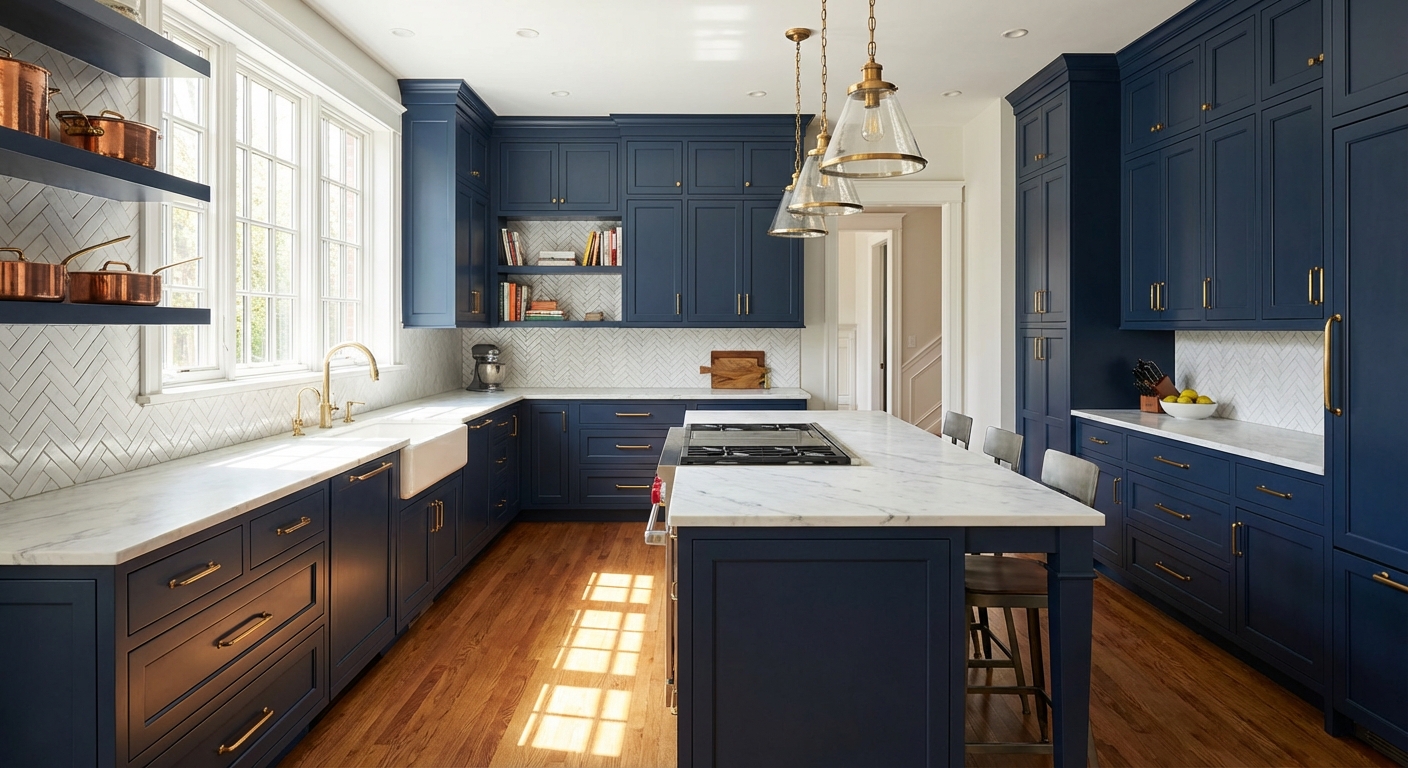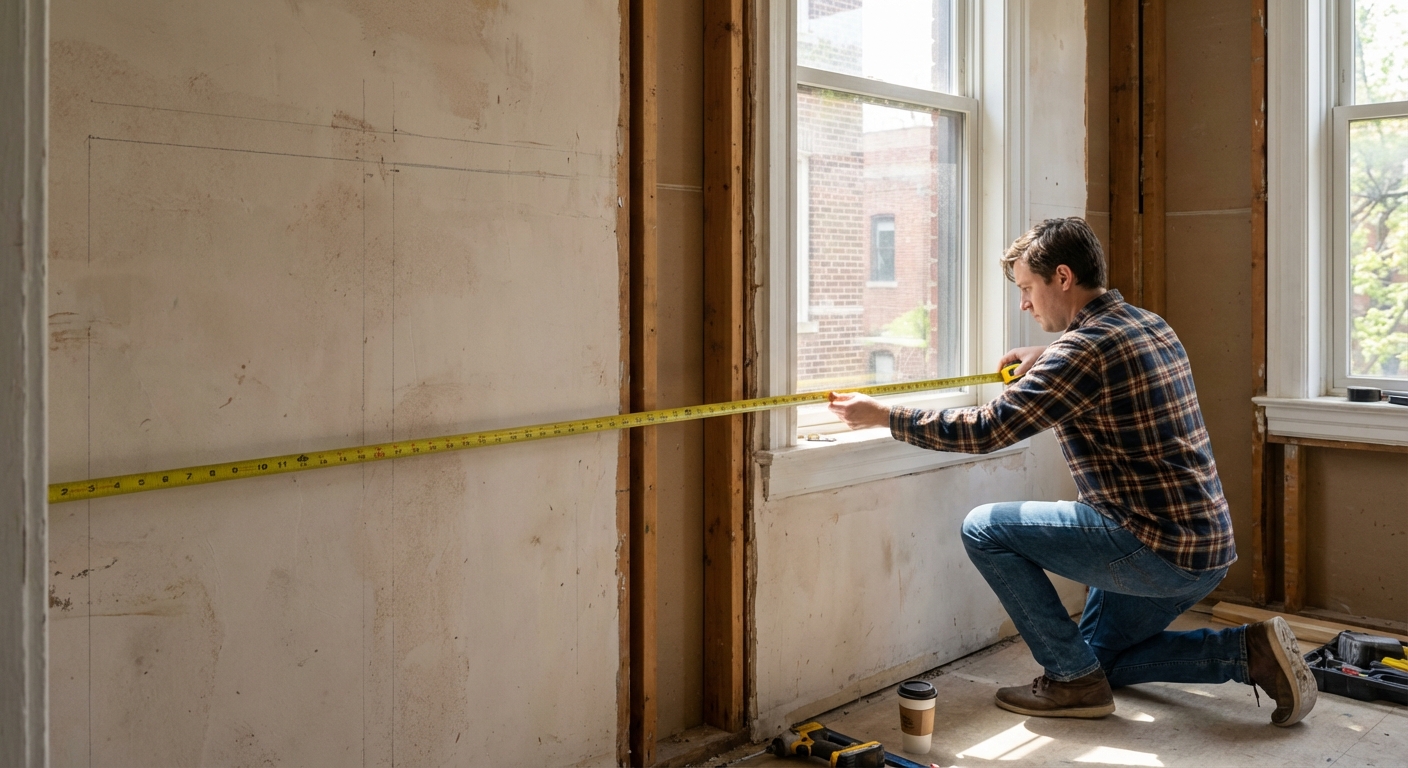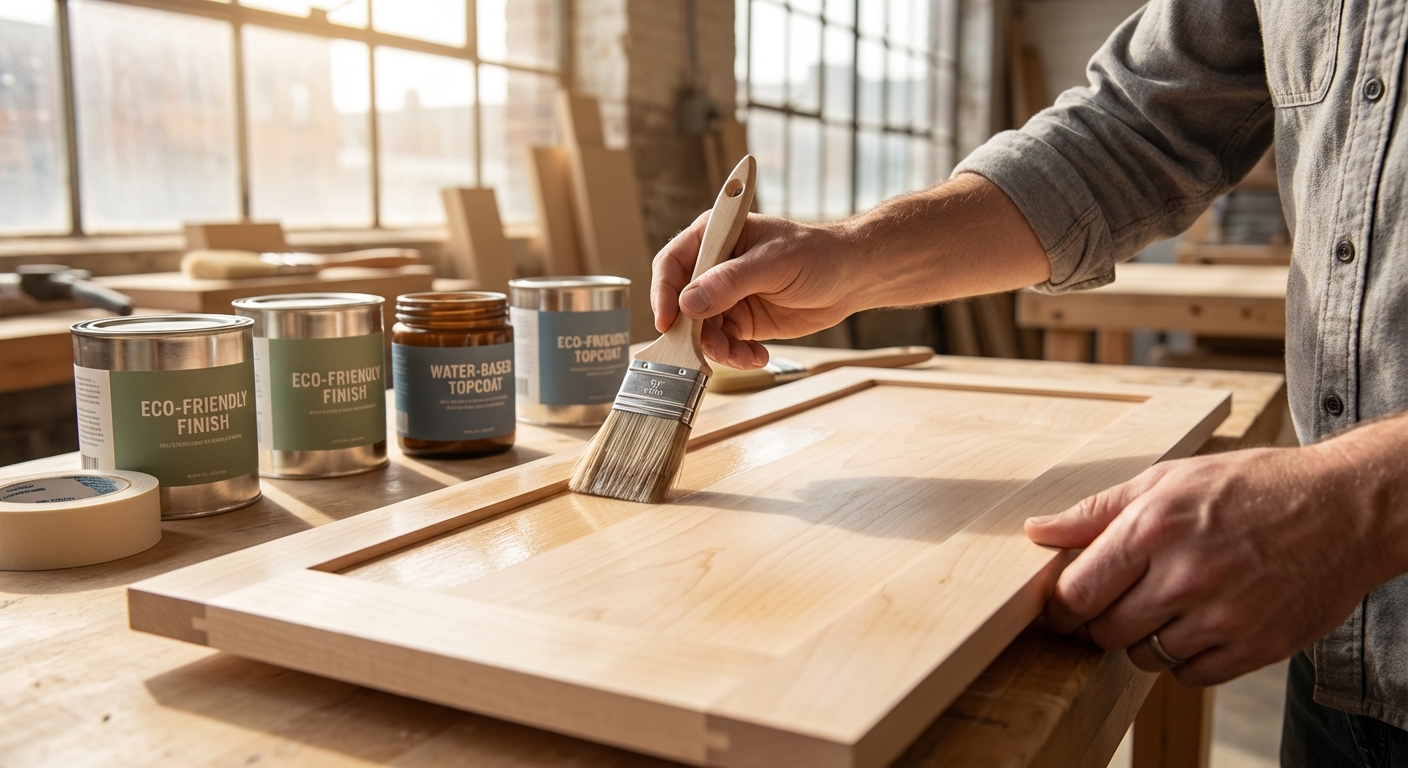
Three months ago, a young family in Roscoe Village called me about their 1940s brick two-flat. They had a toddler who was constantly touching every surface in the kitchen, and the parents were worried about the yellowing lacquer on their old cabinets off-gassing formaldehyde into their living space. They wanted new custom kitchen cabinets for their Chicago home but insisted on finishes that wouldn't compromise their daughter's health. That project pushed me deeper into low-VOC finishing than I'd ever gone — and I haven't looked back since.
Key Takeaways
- Low-VOC cabinet finishes emit fewer than 150 grams per liter of volatile organic compounds compared to 350-500 g/L in conventional lacquers
- Water-based polyurethane and acrylic lacquers now match the durability of solvent-based finishes for kitchen cabinet use
- Chicago's humidity range of 35%-85% throughout the year demands finishes with strong moisture resistance
- Eco-friendly finishes add roughly $800-$2,500 to a full kitchen cabinet project depending on the product line
- Proper curing of low-VOC finishes takes 14-21 days before cabinets reach full hardness and chemical resistance
What Makes a Cabinet Finish "Eco-Friendly" in the First Place
I hear the term "eco-friendly" thrown around a lot, and most of the time it's marketing fluff. In the cabinet finishing world, "eco-friendly" has a specific meaning rooted in chemistry. It refers to finishes with reduced volatile organic compounds — those carbon-based chemicals that evaporate at room temperature and contribute to indoor air pollution and ground-level ozone. The National Kitchen and Bath Association recommends low-VOC products as a best practice for residential cabinetry, especially in homes with children or individuals with respiratory conditions. Conventional solvent-based lacquers typically contain 350-500 grams per liter of VOCs, while low-VOC alternatives stay below 150 g/L, and zero-VOC products come in under 5 g/L.
Beyond VOC content, I also look at what's not in the formula. The best eco-friendly finishes eliminate formaldehyde, isocyanates, and heavy metal driers. They use plant-based or water-based solvents instead of petroleum-derived ones. At our shop, I've tested dozens of products over the past three years and narrowed the field down to a handful that actually perform under real kitchen conditions — grease splatter, steam from boiling water, Chicago's brutal humidity swings, and the constant opening and closing that Blum soft-close hinges handle so well.
Low-VOC Finish Types Compared: What Works for Chicago Cabinets
Not every low-VOC finish works for every situation. I break them into five main categories, and each one has strengths and weaknesses that matter specifically in Chicago homes. Water-based acrylic lacquer is my most-used eco option because it sprays beautifully, dries fast, and doesn't yellow over time on white or light-colored cabinets. Water-based polyurethane is tougher but can raise the grain on certain woods, requiring extra sanding between coats. Natural oil finishes like tung oil and linseed oil are zero-VOC and gorgeous, but they don't build a film and need reapplication every 12-18 months in a working kitchen.
| Finish Type | VOC Level (g/L) | Durability (1-10) | Dry Time | Best For |
|---|---|---|---|---|
| Water-Based Acrylic Lacquer | 50-150 | 8 | 30-60 min | Painted cabinets, light stains |
| Water-Based Polyurethane | 50-100 | 9 | 2-4 hours | Natural wood, high-traffic kitchens |
| Natural Tung Oil | 0-5 | 5 | 24-48 hours | Open-grain wood, low-use areas |
| UV-Cured Acrylic | 0-10 | 10 | Seconds (UV lamp) | Factory production, flat panels |
| Plant-Based Hardwax Oil | 0-30 | 6 | 8-12 hours | European-style, matte finishes |
UV-cured acrylic is the gold standard for eco performance because it converts nearly 100% of its material into solid film with almost zero emissions. The catch is it requires industrial UV curing equipment. I use it for flat-panel doors and drawer fronts where the geometry allows even UV exposure. For frame components and complex profiles, I switch to water-based acrylic lacquer applied with HVLP spray guns at 25-30 PSI.
Why Chicago's Climate Demands Careful Finish Selection
Chicago is a finish killer, plain and simple. I've seen cabinets from other shops delaminate, crack, and peel within 18 months because the finish couldn't handle the humidity swings. In January, heated indoor air drops to 15%-20% relative humidity. By July, you're looking at 70%-85% with the windows open. That range causes wood to expand and contract by as much as 1/8 inch across a 24-inch panel, and the finish has to flex with it or it cracks. Water-based polyurethane has superior elasticity compared to nitrocellulose lacquer, which is one reason I've moved almost entirely away from solvent-based products for custom cabinets in any room.
Moisture resistance matters even more around sinks and dishwashers. I've pulled apart base cabinets in Lakeview and Wicker Park condos where the original finish broke down from steam exposure within just 2-3 years. Our water-based acrylic lacquer, applied in three coats at 4-5 mils dry film thickness, resists moisture penetration as effectively as conventional lacquer. I test every batch with a 24-hour water spot test before any cabinet leaves the shop, and our 5-year warranty covers finish failure from normal use.
Need expert advice? Call (224) 808-5100 or schedule a free kitchen design consultation.
The Real Cost of Going Low-VOC for Your Kitchen Cabinets
Let me be honest about the numbers because I think every homeowner deserves transparency. Switching from a conventional solvent-based lacquer to a quality low-VOC water-based system adds roughly $800-$2,500 to a full kitchen cabinet project. That cost comes from three places: the finish material itself costs 25%-40% more per gallon, water-based products require more controlled application conditions (temperature between 65-75°F, humidity below 50%), and we apply an additional coat for maximum durability. For a complete kitchen starting at $15,000, the eco-upgrade represents a modest percentage of the total investment.
| Kitchen Size | Standard Finish Cost | Low-VOC Finish Cost | Difference |
|---|---|---|---|
| Small (8-10 cabinets) | $1,200-$1,800 | $2,000-$2,800 | +$800-$1,000 |
| Medium (15-20 cabinets) | $2,000-$3,000 | $3,200-$4,500 | +$1,200-$1,500 |
| Large (25+ cabinets) | $3,200-$4,500 | $5,000-$7,000 | +$1,800-$2,500 |
Where you get the money back is in longevity and health. Low-VOC finishes don't yellow on white cabinets, which means your painted shaker doors will still look crisp in 8-10 years instead of turning amber in 3-4 years. You also avoid the need for professional recoating, which can run $3,000-$6,000 for a full kitchen. I walk clients through these numbers during every consultation because I want them to understand the total cost of ownership, not just the upfront price. If you're considering a full kitchen renovation, our kitchen cabinet dimensions guide is a solid starting point for planning.
Materials That Pair Best with Eco-Friendly Finishes
The finish is only as good as the substrate underneath it. I primarily build cabinet boxes from 3/4-inch Baltic birch plywood because it's dimensionally stable, takes finish well, and off-gasses far less than particle board. For door panels, I use either solid hardwood (maple, white oak, or walnut) or EGGER thermolaminate panels that carry E1 emissions certification — meaning formaldehyde emissions below 0.1 ppm. Pairing a low-VOC finish with a low-emission substrate creates a cabinet system that's clean from the inside out.
- Maple: Tight, closed grain absorbs water-based finishes evenly with minimal grain raising
- White Oak: Open grain looks spectacular under hardwax oil or water-based polyurethane
- Walnut: Natural oils in walnut pair beautifully with tung oil or plant-based finishes
- MDF (CARB2 Certified): Ideal for painted cabinet doors when paired with water-based primer and acrylic lacquer
- Baltic Birch Plywood: Our standard box material — accepts all eco-friendly finish types
For custom bathroom vanities, I'm especially careful about substrate selection because moisture exposure is constant. I use marine-grade plywood for sink bases and apply four coats of water-based polyurethane on all surfaces, including the interior. In custom closet systems, where moisture and chemical exposure are lower, I sometimes use a two-coat hardwax oil that gives a beautiful matte European look while keeping VOCs near zero.
Application Process: How We Apply Low-VOC Finishes in Our Shop
Our finishing process takes 5-7 days from first coat to final inspection. It starts with sanding all components to 180-grit, then raising the grain with a light mist of water and sanding again to 220-grit. This grain-raising step is critical with water-based products because if you skip it, the first coat of finish will raise the grain and leave a rough surface. I then apply a water-based sanding sealer, sand to 320-grit, and follow with two to three coats of the topcoat finish. Each coat goes on at 3-4 wet mils using HVLP guns in our climate-controlled spray booth held at 68°F and 45% humidity.
Between coats, I allow a minimum of 2 hours of drying time, then scuff-sand with 320-grit to ensure mechanical adhesion. The final coat gets a 48-hour cure in the booth before handling. Full chemical cure — meaning the finish reaches maximum hardness and moisture resistance — takes 14-21 days. I always tell clients not to use harsh chemical cleaners on new cabinets for the first three weeks. Our 21-day production timeline at AK Cabinet Craft accounts for this curing process, so cabinets arrive at your home ready to install and nearly fully cured.
Common Mistakes Homeowners Make with Eco-Friendly Finishes
The biggest mistake I see is homeowners buying "green" labeled products from big-box stores and thinking they're getting the same performance as professional-grade low-VOC finishes. Consumer-grade water-based polyurethane from the hardware store is formulated for DIY application with a brush, which means it has flow agents and retarders that reduce hardness. Professional-grade products like the ones we spray in our booth have higher solids content — 35%-45% compared to 25%-30% for consumer products — which means a harder, more durable film.
- Using "zero-VOC" paint without a compatible primer, leading to adhesion failure within 6-12 months
- Applying finishes in uncontrolled environments — garages, basements — where temperature and humidity fluctuate
- Skipping the grain-raising step on raw wood, resulting in a rough texture after the first coat
- Not allowing full cure time before mounting hardware or loading shelves
- Mixing finish brands between primer and topcoat, causing compatibility issues like fisheye and cratering
Another common issue is choosing natural oil finishes for high-use kitchen cabinets. Tung oil and linseed oil are gorgeous on a dining table or custom built-in bookcases, but they don't form a protective film. In a kitchen where grease, water, and tomato sauce are daily hazards, you need a film-forming finish. I reserve oil finishes for display shelving, pantry interiors, and closet components where the wear profile is much gentler.
2026 Trends in Eco-Friendly Cabinet Finishes
The finish industry has made massive strides in the last two years. Bio-based resins derived from soybean and cashew nut shell oil are now available in commercial-grade lacquers, reducing petroleum dependency by 40%-60%. I've started testing a soy-based acrylic lacquer on sample panels and the results after 6 months of kitchen simulation testing are impressive — comparable scratch resistance to conventional products with VOCs under 50 g/L. UV-LED curing technology has also dropped in price, making it accessible to mid-size shops like ours for flat-panel production runs.
The matte finish trend isn't going anywhere in 2026. Chicago homeowners overwhelmingly request matte or satin sheens — about 75% of our projects this year — and low-VOC water-based finishes excel in low-sheen applications. Unlike solvent-based lacquers that can look plasticky in matte, water-based products produce a natural, hand-rubbed appearance that highlights wood grain beautifully. At AK Cabinet Craft, our team has completed 1,300+ projects across Chicago, and I can tell you the shift toward eco-friendly finishes has accelerated dramatically. About 40% of our clients now specifically request low-VOC options compared to 15% just three years ago. Explore our completed projects gallery to see how these finishes look in real Chicago kitchens.
Frequently Asked Questions
Do low-VOC cabinet finishes last as long as traditional finishes?
Yes, when applied professionally. The water-based polyurethanes and acrylic lacquers I use are formulated with cross-linking resins that achieve hardness levels within 5%-10% of solvent-based equivalents. In my testing over the past three years, properly applied low-VOC finishes show no meaningful difference in scratch resistance, moisture resistance, or adhesion compared to traditional lacquers. The key is professional spray application in a controlled environment — not brushing from a can in your garage.
How long does the smell last with low-VOC cabinet finishes?
Most of our clients report that the mild odor from water-based finishes dissipates within 48-72 hours after installation. Compare that to solvent-based lacquers, which can off-gas noticeable fumes for 2-4 weeks. I always recommend keeping windows open and running ventilation for the first few days after cabinet installation, but with low-VOC products, the air quality impact is minimal. Families with newborns or allergy-sensitive members can usually resume normal kitchen use within 3-5 days.
Can I get a high-gloss look with eco-friendly finishes?
Absolutely. Water-based acrylic lacquer can achieve gloss levels up to 90+ gloss units when applied in multiple coats and wet-sanded between applications. The process requires more labor than achieving a matte or satin sheen, which is why high-gloss eco finishes add roughly $500-$1,200 to a project. I recommend high-gloss for contemporary flat-panel designs where the finish becomes a design element, and I use UV-cured acrylic for the hardest, most mirror-like results.
Are eco-friendly finishes safe for homes with young children?
That's exactly why I transitioned to these products. Once fully cured — 14-21 days — low-VOC and zero-VOC finishes are chemically inert and safe for direct contact. They contain no lead, no formaldehyde, and no phthalates. The family in Roscoe Village I mentioned at the beginning of this article has had their new kitchen for three months now, and their indoor air quality test showed VOC levels below 50 ppb — well within healthy range.
What's the difference between low-VOC and zero-VOC finishes?
Low-VOC finishes contain fewer than 150 g/L of volatile organic compounds, while zero-VOC products contain fewer than 5 g/L. In practice, zero-VOC options are limited to certain paint formulations and natural oil finishes. For cabinet-grade lacquers that need to withstand kitchen conditions, low-VOC in the 50-100 g/L range represents the best balance of performance and environmental responsibility. I wouldn't sacrifice durability for a marketing label — a finish that fails in two years creates more waste than one with slightly higher VOCs that lasts a decade.
Ready to Get Started?
If you're planning a kitchen renovation and want finishes that protect both your family and the environment, I'd love to walk you through the options in person. At AK Cabinet Craft, we build every cabinet from scratch at our Chicago shop using low-VOC finishes, Blum hardware, and materials selected specifically for Midwest conditions. Schedule a free kitchen design consultation or call (224) 808-5100 — I'll bring finish samples so you can see and feel the difference yourself.