A couple in a Roscoe Village greystone came to me last spring with a request I hear more and more: they wanted sustainable kitchen cabinets that wouldn't compromise on durability. They'd narrowed their search to bamboo vs birch cabinets but couldn't find anyone in Chicago who'd actually built with both materials in this climate. I've worked extensively with both over the past 14 years, and I can tell you the answer isn't as straightforward as most blog posts make it seem.
Key Takeaways
- Bamboo cabinets are 25-30% harder than birch on the Janka scale, making them more dent-resistant for busy Chicago kitchens
- Birch plywood outperforms bamboo in dimensional stability when Chicago's humidity swings from 15% in winter to 75% in summer
- Bamboo cabinet projects typically cost $18,000-$32,000 for a full kitchen, while birch runs $15,000-$26,000
- Both materials accept stain well, but birch offers a more traditional grain pattern that suits Chicago bungalows and greystones
- Bamboo reaches harvestable maturity in 3-5 years versus birch's 40-50 year growth cycle, giving it a clear sustainability edge
Understanding Bamboo as a Cabinet Material
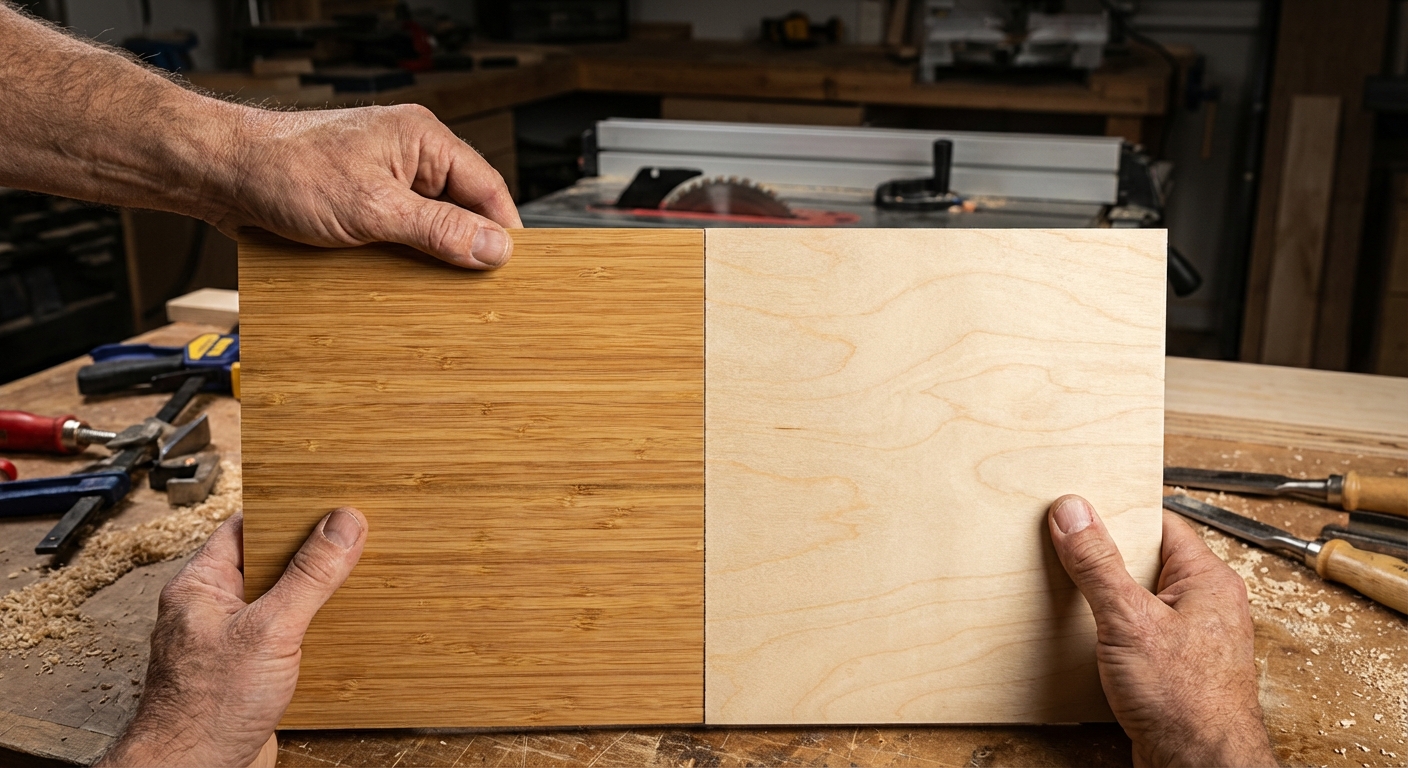
Bamboo isn't technically a hardwood — it's a grass. But don't let that fool you. Strand-woven bamboo registers a Janka hardness of approximately 3,000-4,000 lbf, which puts it well above white oak, maple, and certainly birch. I use bamboo plywood in 3/4-inch panels, typically sourced from Moso bamboo grown in managed plantations. The material arrives as laminated strips that are either horizontally pressed (showing the bamboo nodes) or vertically pressed (creating a more uniform, linear look).
The sustainability case for bamboo is genuinely strong. A bamboo culm reaches full maturity in 3-5 years and can be harvested without killing the root system, so the plant regrows. Compare that to a birch tree that needs 40-50 years before it's ready for lumber. When clients in Wicker Park or Logan Square tell me they want the greenest option possible, bamboo is usually my first recommendation.
That said, bamboo has quirks. The adhesives used in lamination matter enormously — I only source panels that use formaldehyde-free resins, and I verify the CARB Phase II compliance on every shipment. Cheap bamboo plywood from unverified mills can off-gas and delaminate, especially in Chicago's humidity swings. I've torn out bamboo cabinets from other installers that were buckling after just 2 years because the material was substandard. Quality bamboo plywood costs more, but it's the only kind I'll put my name on.
Understanding Birch as a Cabinet Material
Birch has been a cabinet-shop staple in the Midwest for generations, and for good reason. Baltic birch plywood — the grade I spec for cabinet boxes — uses 13 plies in a 3/4-inch panel, creating a void-free core that machines beautifully and holds screws with serious tenacity. The Janka hardness of solid birch sits around 1,260 lbf, which is softer than bamboo but perfectly adequate for cabinet doors and face frames.
Birch's grain is fine, uniform, and accepts stain predictably. I've matched birch cabinets to everything from honey-toned finishes in Ravenswood Victorians to cool grey tones in River North condos. The wood's natural color is a pale cream with occasional reddish-brown heartwood streaks, which some clients love for character and others prefer to avoid. When I'm building custom kitchen cabinets for Chicago homes, birch gives me the flexibility to hit almost any aesthetic the homeowner wants.
From a sustainability standpoint, birch is better than many alternatives. It grows abundantly across the northern United States and Canada, and well-managed forests replant aggressively. The Forest Stewardship Council (FSC) certifies a significant portion of North American birch lumber. However, that 40-50 year growth cycle means birch simply can't match bamboo's renewability metrics. Birch is a responsible choice, but bamboo is the more sustainable one on paper.
Need expert advice? Call (224) 808-5100 or schedule a free kitchen design consultation.
Bamboo vs Birch Cabinets: Head-to-Head Comparison
I've built enough projects with both materials to give you an honest, experience-based comparison. The table below covers the specs I evaluate for every Chicago kitchen project. Keep in mind, these numbers reflect the quality-grade materials I source — not the cheapest options on the market.
| Property | Bamboo (Strand-Woven) | Birch (Baltic Plywood) |
|---|---|---|
| Janka Hardness | 3,000-4,000 lbf | 1,260 lbf |
| Renewability Cycle | 3-5 years | 40-50 years |
| Full Kitchen Cost | $18,000-$32,000 | $15,000-$26,000 |
| Humidity Stability | Good with quality lamination | Excellent (13-ply structure) |
| Stain Acceptance | Good — best with lighter tones | Excellent — takes any stain |
| Grain Character | Modern, linear | Traditional, fine-grained |
| Availability in Midwest | Moderate — imported | High — domestic supply |
| Typical Panel Thickness | 3/4 inch | 3/4 inch (13-ply) |
One thing this table doesn't capture is feel. When I hand clients a sample of each material, the bamboo always surprises them — it's noticeably denser and heavier. Birch feels lighter and more familiar. Both machine cleanly on a CNC, though bamboo generates more heat during cutting and dulls router bits roughly 20% faster. That's a production cost I factor into quotes. The aesthetic difference is significant too: bamboo reads as distinctly modern, while birch can swing either contemporary or traditional depending on the door profile and finish.
How Chicago's Climate Affects Both Materials
Chicago's climate is brutal on cabinetry. I've measured indoor relative humidity dropping to 15-18% during January when forced-air heating runs constantly, then climbing to 70-75% in a kitchen during a humid August cook session. That 50+ percentage-point swing is what separates materials that last from materials that self-destruct. Every material I use has to survive this cycle for years without warping, cracking, or delaminating.
Birch plywood handles these swings exceptionally well. The alternating grain direction in 13 plies of Baltic birch creates a panel that resists expansion and contraction in all directions. I've installed birch cabinet boxes in lakefront condos where kitchen windows are left open in summer, and they've held perfect alignment for over a decade. This dimensional stability is why birch remains my go-to for cabinet boxes regardless of what material I use for doors and face frames.
Bamboo can handle Chicago's humidity — but only if the lamination is top quality. The adhesive bonds between bamboo strips are the weak point. In lower-grade bamboo panels, moisture cycling causes micro-delamination at the glue lines, leading to surface checks and eventual structural failure. I've consulted on two kitchen tear-outs where this exact failure occurred within 3 years. The panels I source use phenolic resin adhesives rated for exterior exposure, which is frankly overkill for kitchen cabinetry, but that overkill is what guarantees long-term performance in Chicago.
If you're considering either material for a bathroom vanity, the stakes are even higher. I discuss material selection for moisture-heavy environments in my custom bathroom vanity projects, where I often recommend a hybrid approach — birch plywood boxes with bamboo or other decorative door faces.
Sustainability Credentials: Looking Beyond the Headlines
Sustainability is more nuanced than growth cycles. Yes, bamboo regrows in 3-5 years, but most bamboo used in American cabinetry ships from Southeast Asia. That means container shipping with its associated carbon footprint, plus the energy cost of processing raw bamboo into laminated panels. The National Kitchen and Bath Association has been pushing the industry to consider full lifecycle assessments rather than just renewability metrics, and I think that's the right approach.
Birch, by contrast, is harvested domestically. The Baltic birch plywood I use comes from sustainably managed forests in Russia, Finland, and the Baltic states, while solid birch lumber often comes from Michigan, Wisconsin, and Minnesota. Shorter supply chains mean less transportation emissions. However, a 40-50 year growth cycle means we're consuming trees far slower than bamboo plantations can produce equivalent material.
My honest recommendation? If pure sustainability is your top priority, bamboo wins on renewability. If you factor in supply chain emissions and domestic sourcing, birch closes the gap significantly. Either way, both materials are far more sustainable than the particleboard and MDF construction you'll find in most big-box store cabinets. When I build custom cabinets for Chicago homes, I use materials that last 20+ years, and longevity is the most sustainable feature of all — a cabinet that never needs replacing has zero replacement footprint.
Hardware Compatibility and Construction Details
Both bamboo and birch work well with premium hardware, but there are differences in how each material receives screws and mounting plates. I install Blum CLIP top hinges and TANDEMBOX drawer systems on every project at AK Cabinet Craft, and I've tested both materials extensively with these components. Birch plywood holds hinge mounting plate screws with 20-25% greater pullout resistance than bamboo plywood of the same thickness, thanks to its cross-laminated grain structure.
For bamboo, I pre-drill every hinge screw hole and use slightly longer screws — typically 5/8-inch instead of 1/2-inch — to ensure the hinge plates stay locked in place over thousands of open-close cycles. I also apply a drop of CA (cyanoacrylate) glue in hinge bores on bamboo doors as an extra precaution. These are small details that most homeowners never see, but they're the difference between doors that stay aligned for 5+ years and doors that start sagging after 18 months.
Drawer box construction is another consideration. I build drawer boxes from 5/8-inch Baltic birch regardless of whether the cabinet exteriors are bamboo or birch. The cross-laminated plies give Blum TANDEMBOX runners a rock-solid mounting surface. If you want to understand how proper dimensions and hardware integration work together, my kitchen cabinet dimensions guide covers the specifics.
- Hinge mounting: Birch holds screws better; bamboo requires pre-drilling and longer fasteners
- Drawer boxes: I recommend birch plywood for both materials due to superior screw holding
- Shelf pins: Both materials hold standard 5mm shelf pins securely at 3/4-inch thickness
- Rail and stile joinery: Bamboo requires sharper tooling and slower feed rates on the CNC
Cost Breakdown: What to Expect in Chicago
Pricing for bamboo vs birch cabinets depends on kitchen size, door style, finish, and hardware selection. At AK Cabinet Craft, our team has completed 1,300+ projects, so I can give you realistic ranges based on actual kitchen builds — not theoretical estimates. The table below reflects installed pricing for a typical Chicago kitchen with 20-25 linear feet of cabinetry.
| Cost Component | Bamboo Kitchen | Birch Kitchen |
|---|---|---|
| Cabinet Boxes (20-25 LF) | $8,000-$12,000 | $7,000-$10,000 |
| Doors & Drawer Fronts | $5,000-$9,000 | $4,000-$7,500 |
| Blum Hardware Package | $2,500-$4,500 | $2,500-$4,500 |
| Finishing & Installation | $2,500-$6,500 | $1,500-$4,000 |
| Total Installed | $18,000-$32,000 | $15,000-$26,000 |
The cost premium on bamboo comes from three places: imported material pricing, faster tooling wear during production, and the finishing process. Bamboo's dense fiber structure absorbs stain differently than wood, so achieving an even finish requires additional sanding passes and careful sealer application. None of these costs are prohibitive, but they add up across a full kitchen. Both options fall within what most Chicago homeowners budget for quality cabinetry, especially compared to walnut or white oak alternatives that can push past $40,000.
Our production timeline stays at 21 days for both materials. If you're looking at ready-made kitchen design lines for a faster turnaround, those use pre-selected materials and finishes that can shave time off the process.
Which Material Should You Choose for Your Chicago Home?
After building with both materials in every type of Chicago home — from 800-square-foot Lakeview condos to 3,500-square-foot Bucktown single-family renovations — here's my recommendation framework. Choose bamboo if you prioritize maximum surface hardness, a distinctly modern aesthetic, and the strongest possible sustainability story. It's ideal for contemporary kitchens with flat-panel door styles where the linear grain pattern becomes a design feature.
Choose birch if you want proven dimensional stability in Chicago's climate swings, a versatile canvas for any stain color, and a lower price point. Birch suits transitional and traditional kitchens equally well, and it's the material I reach for when clients want that warm, classic Midwestern kitchen feel. For homes with custom built-ins in challenging spaces, birch's workability gives me more flexibility in non-standard configurations.
I also frequently recommend a hybrid approach: bamboo doors and face frames for their hardness and visual impact, mounted on birch plywood cabinet boxes for their dimensional stability and screw-holding power. This gives you the best performance characteristics of both materials while keeping the total project cost closer to the birch-only range. It's the approach I used for that Roscoe Village greystone kitchen I mentioned at the top, and the clients have been thrilled with the result.
- Best for modern kitchens: Bamboo doors with natural or clear-coat finish
- Best for traditional kitchens: Birch with medium stain and raised-panel profiles
- Best hybrid approach: Bamboo doors on birch plywood boxes
- Best for tight budgets: Full birch construction starting at $15,000
- Best for maximum durability: Strand-woven bamboo doors with birch boxes
Frequently Asked Questions
Are bamboo cabinets truly more eco-friendly than birch?
On a renewability basis, yes — bamboo regrows in 3-5 years compared to birch's 40-50 years. But when I factor in overseas shipping emissions and processing energy, the gap narrows. I tell my clients that both materials are excellent sustainable choices, especially compared to particleboard alternatives. The most sustainable cabinet is one that lasts 20+ years without needing replacement.
Will bamboo cabinets warp in Chicago's humidity?
Not if you use quality material. I source bamboo panels with phenolic resin adhesives and CARB Phase II compliance. These panels handle Chicago's humidity swings from 15% to 75% without issue. The failures I've seen always trace back to cheap, poorly laminated panels. I test every batch that enters my shop.
Can birch cabinets be stained to look like walnut or cherry?
Absolutely. Birch accepts stain beautifully, and I regularly match it to darker species. The key is a proper sanding sequence — I go through 120, 150, and 220 grit — followed by a pre-stain conditioner to ensure even absorption. I've produced birch cabinets in espresso, cognac, and warm chestnut tones that clients couldn't distinguish from far more expensive hardwoods.
How long do bamboo and birch cabinets last in a Chicago kitchen?
With quality construction and proper finishing, both materials should last 20-30 years minimum. At AK Cabinet Craft, we back every project with a 5-year warranty on materials and workmanship. The Blum hardware I install is rated for 200,000+ open-close cycles, so the mechanical components will outlast most kitchens.
Do you offer bamboo cabinet options at AK Cabinet Craft?
Yes. I build with both bamboo and birch, and I also offer the hybrid approach — bamboo doors on birch boxes. I keep sample panels in the shop so you can see and feel both materials before committing. Call us at (224) 808-5100 to set up a time to compare them in person.
Ready to Get Started?
Whether you're leaning toward bamboo, birch, or a combination of both, I'd love to walk you through the samples and help you choose the right material for your Chicago home. At AK Cabinet Craft, we've built 1,300+ projects across every neighborhood in the city, and our 5.0 Google rating reflects the care we put into every cabinet. Schedule a free kitchen design consultation or call (224) 808-5100 — I'll have material samples ready for you.