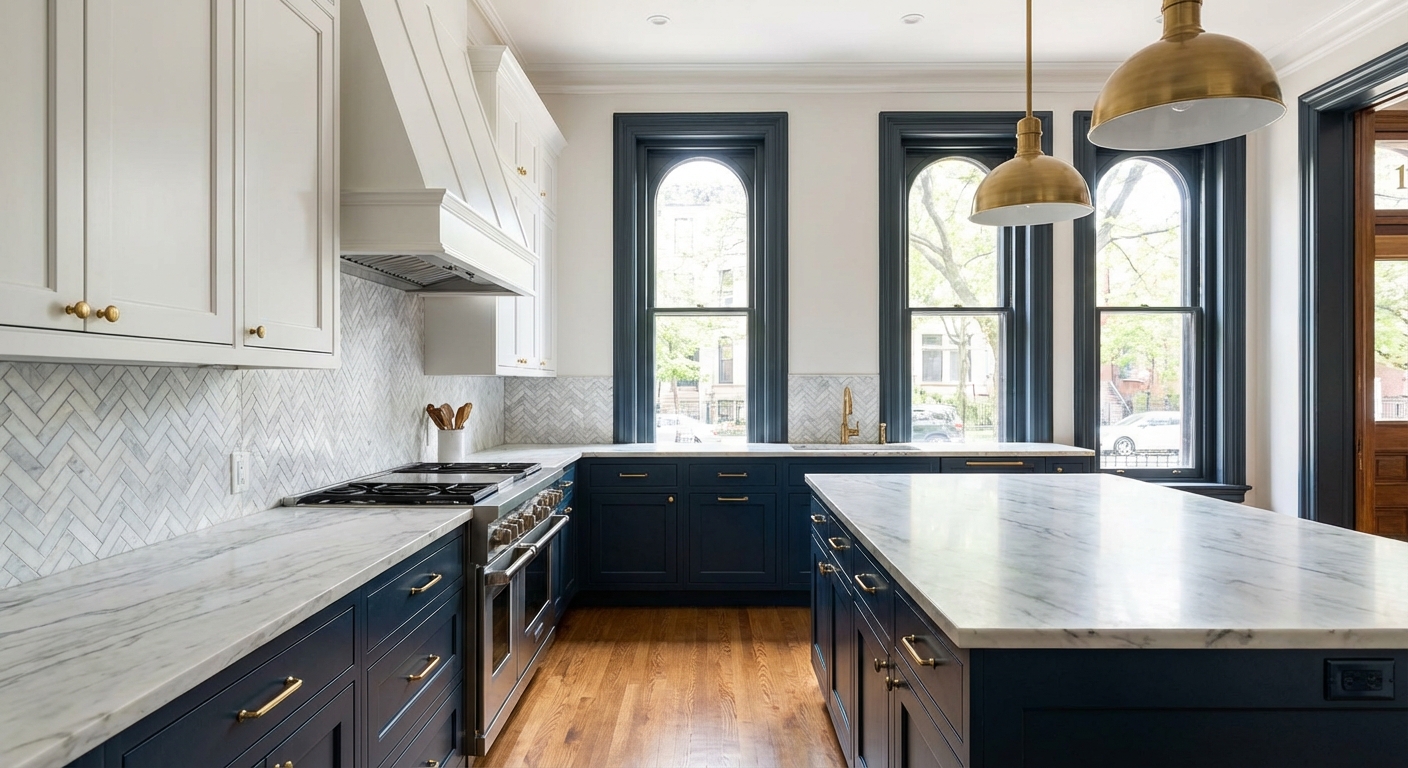
Last month I helped a young family in a Lakeview two-flat completely rethink their kitchen storage. They had 22 linear feet of cabinetry — decent by Chicago standards — but every drawer was a chaotic jumble of spatulas, zip ties, takeout menus, and mystery lids without matching containers. The wife told me she spent 10 minutes every morning just hunting for her coffee scoop. Sound familiar? That project reminded me why drawer inserts and dividers aren't a luxury — they're the difference between a kitchen that works and one that quietly drives you crazy.
Key Takeaways
- Well-planned drawer inserts can recover up to 30% of wasted drawer space in the average kitchen.
- The right divider system depends on drawer depth — standard (4 inches), mid-depth (6 inches), and deep (10+ inches) each need different solutions.
- Quality inserts from brands like Blum last decades, while cheap plastic organizers warp within a year.
- Every drawer in your kitchen should have a single purpose — utensils, prep tools, wraps, or spices — never a mix of everything.
- Custom drawer inserts typically cost $50 to $300 per drawer depending on material and complexity.
Why Kitchen Drawer Organization Actually Matters
I've walked into over 400 kitchens across Chicago, and I can tell you the number one complaint isn't about cabinet color or countertop material — it's about not being able to find anything. Disorganized drawers don't just waste your time; they waste your space. When items pile up without structure, you end up using only the top layer and forgetting what's buried beneath. Studies from the National Kitchen and Bath Association show that kitchen organization ranks among the top three priorities for homeowners planning a remodel. The good news is that you don't always need a full renovation to fix the problem. Sometimes the smartest upgrade is what goes inside your existing drawers, not the drawers themselves.
Step 1: Audit Every Drawer in Your Kitchen
Before you buy a single insert, you need to empty every kitchen drawer and sort the contents into categories. I recommend four piles: keep, relocate, donate, and toss. Be ruthless — if you haven't used that avocado slicer in 12 months, it's taking up real estate you need. Once everything is sorted, measure each drawer's interior width, depth, and height. Write these dimensions down because you'll need them when selecting inserts. This audit typically takes about 45 minutes for a standard Chicago kitchen, and it's the single most important step in the entire process.
- Width: Measure the inside face of the drawer box, not the front panel.
- Depth: Measure front to back, accounting for the drawer slide mechanism.
- Height: Measure from the drawer bottom to the top edge of the drawer box.
- Slide type: Note whether you have side-mount or undermount slides — this affects usable interior width.
Step 2: Assign a Purpose to Every Drawer
Here's the rule I give every client: one drawer, one job. Your utensil drawer holds utensils — not also batteries, pens, and rubber bands. I typically recommend organizing drawers by zone based on how you move through your kitchen. Prep tools go near the cutting board area, cooking utensils near the stove, and serving pieces near the dining area. In compact Chicago condos, this zone approach can shave minutes off meal prep because everything is within arm's reach of where you need it. If you're working with a kitchen that has fewer than 8 drawers, you may need to double up categories, but inserts with separate compartments make that manageable. For deeper guidance on planning kitchen layouts, check out our kitchen cabinet dimensions guide.
| Drawer Zone | Best Location | Recommended Insert Type | Typical Drawer Depth |
|---|---|---|---|
| Utensils & flatware | Near dishwasher | Compartment tray with 5-7 slots | 4 inches |
| Cooking tools | Next to stove | Adjustable peg dividers | 6 inches |
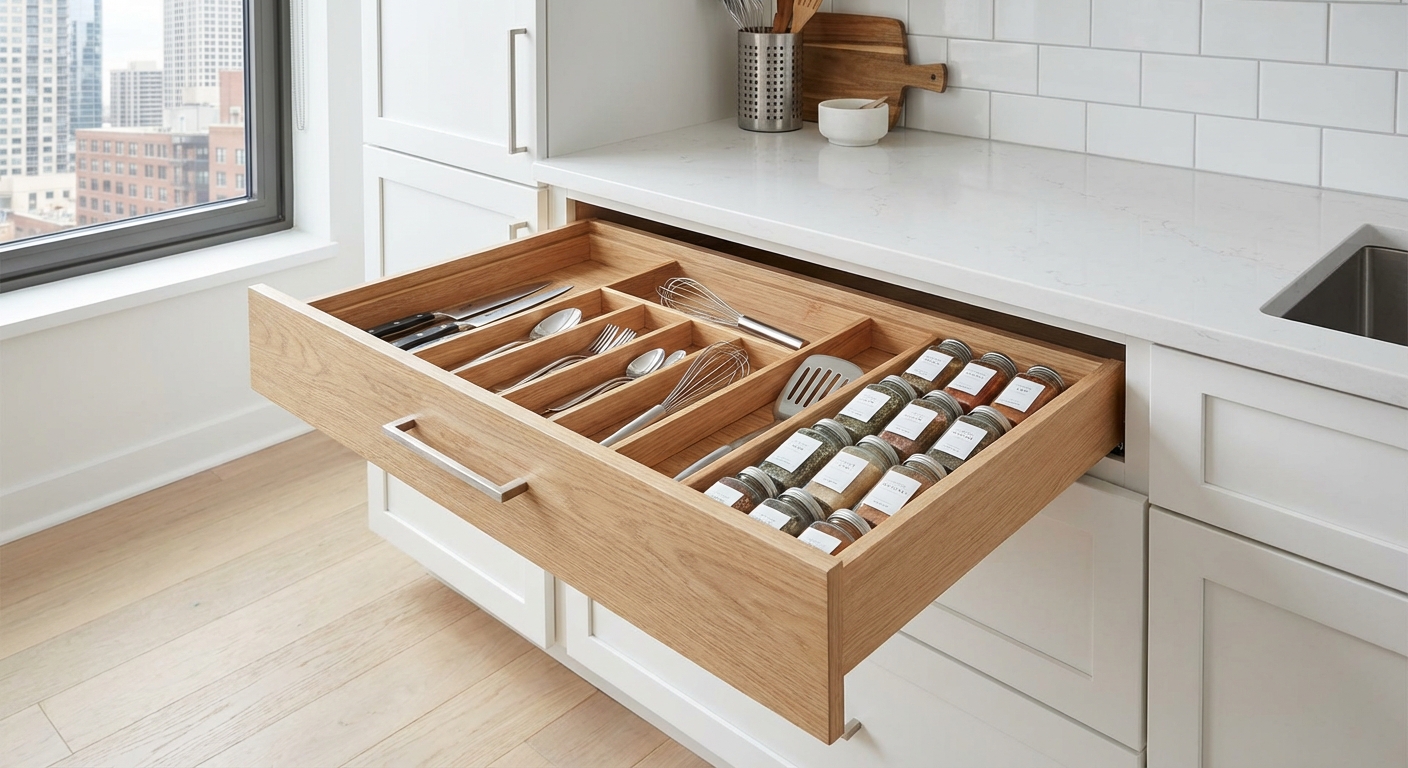
| Spices | Near prep area | Angled tiered insert | 4-6 inches |
| Wraps & bags | Near pantry | Vertical file dividers | 6 inches |
| Pots & lids | Below cooktop | Peg board with lid rack | 10+ inches |
| Baking sheets | Near oven | Vertical tray dividers | 10+ inches |
| Knives | Near prep area | In-drawer knife block | 4 inches |
Need expert advice? Call (224) 808-5100 or schedule a free kitchen design consultation.
Step 3: Choose the Right Insert Material
Not all drawer inserts are created equal, and in my experience, material choice is where most people either nail it or waste money. Solid wood inserts — typically birch, walnut, or maple — are the gold standard for durability and aesthetics. They resist warping, feel premium, and can be custom-sized to fit your exact drawer dimensions. Bamboo is a popular mid-range option that holds up well in kitchens with moderate use. Plastic inserts are the cheapest route at $5 to $20 per tray, but they tend to slide around, crack, and look worn within a year. Stainless steel dividers work beautifully for deep drawers holding pots and pans because they handle weight without bending.
- Solid hardwood: $80-$300 per drawer — best for custom kitchens, lasts 20+ years
- Bamboo: $25-$75 per drawer — good mid-range option, resists moisture
- Plastic/acrylic: $5-$20 per drawer — budget-friendly, but expect annual replacement
- Stainless steel: $60-$150 per drawer — ideal for heavy-duty deep drawers
At AK Cabinet Craft, our team builds custom wood inserts that are precision-fitted to each drawer, which eliminates the sliding and rattling you get with off-the-shelf products. If you're considering a broader kitchen upgrade, our custom kitchen cabinets include fully integrated drawer organization from the start.
Step 4: Install Inserts and Dividers Like a Pro
Installation ranges from drop-in simple to requiring a few tools, depending on the system you choose. Drop-in trays — the most common for utensil drawers — literally just sit inside the drawer and are held in place by their snug fit. Peg-style dividers require drilling a grid of small holes in the drawer bottom, which I recommend spacing at 2-inch intervals for maximum flexibility. For tiered spice inserts, you'll often need to attach an angled riser to the back of the drawer with wood screws. If your drawers use Blum TANDEMBOX systems, the inserts clip directly into the drawer sides without any tools. I always tell clients to test the layout with the actual items before locking anything in place — what looks logical empty might not work once you load it up.

The Deep Drawer Strategy: Pots, Pans, and Lids
Deep drawers — 10 inches or more — are a game-changer for Chicago kitchens where cabinet space is tight, but they become black holes without proper dividers. The best system I've found is a pegboard base with adjustable wooden or metal pegs that create custom compartments for different pot sizes. Lids should always be stored vertically in a separate section or on a wire rack mounted to the back of the drawer. This approach lets you see everything at a glance instead of stacking pots three deep and hoping the one you need is on top. In that Lakeview project I mentioned, we converted two lower cabinets into deep drawers with peg systems, and the client told me it completely changed how she cooks. If your kitchen has awkward corners or odd angles that make standard solutions difficult, our guide on custom built-ins for awkward spaces covers creative solutions.
Organizing Beyond the Kitchen Drawer
The same insert and divider principles that transform kitchen drawers work throughout your home. Bathroom vanity drawers benefit enormously from tiered trays that separate makeup, hair tools, and daily essentials — I design these as part of our custom bathroom vanity projects. Closet drawers for accessories, jewelry, and folded items use similar compartment systems to keep everything visible. Mudroom built-ins with divided drawers keep gloves, scarves, and dog leashes from turning into a tangled mess every winter. The key principle is universal: when every item has a defined home, you spend less time searching and more time living. Our custom closet and wardrobe systems use many of these same organizational strategies scaled to bedrooms and entryways.
Common Mistakes to Avoid
After 6 years of designing storage systems, I've seen every organizational mistake in the book. Here are the ones that come up most often, along with how to fix them before you waste time and money.
- Buying inserts before measuring: Even a quarter-inch discrepancy means your tray will slide, rattle, or not fit at all. Always measure twice.
- Overstuffing drawers: If you have to shove things in to close the drawer, you need to edit the contents — not buy a bigger insert.
- Ignoring drawer weight capacity: Standard drawer slides hold 75 pounds, but premium slides like Blum's MOVENTO handle up to 130 pounds. Loading heavy cookware into drawers with basic slides will damage the mechanism.
- Choosing form over function: That gorgeous walnut knife block won't help if it only fits 6 knives and you own 12. Count your items first, then buy the insert.
- Skipping the junk drawer conversation: Every kitchen has one. Rather than fight it, give it structure with a small-compartment tray and limit it to one drawer only.
What Custom Drawer Inserts Cost in Chicago
Pricing varies widely depending on whether you go DIY, semi-custom, or fully custom. For a typical Chicago kitchen with 8 to 12 drawers, here's what to expect across different approaches. Keep in mind that investing in quality inserts during a kitchen build or remodel is significantly cheaper than retrofitting later, since the drawers can be sized to accommodate specific inserts from day one. At AK Cabinet Craft, our team has completed 1,300+ projects where drawer organization was built into the design from the start, and clients consistently tell us it's the feature they appreciate most in daily life. Our custom cabinets for any room always include a storage planning session to make sure every drawer earns its place.
| Approach | Cost per Drawer | Total for 10 Drawers | Durability |
|---|---|---|---|
| DIY (plastic/bamboo from retail) | $10-$40 | $100-$400 | 1-3 years |
| Semi-custom (online wood inserts) | $50-$120 | $500-$1,200 | 5-10 years |
| Fully custom (built with cabinetry) | $80-$300 | $800-$3,000 | 20+ years |
Frequently Asked Questions
What's the best drawer insert for a small Chicago kitchen with only 6 drawers?
I recommend prioritizing a utensil tray, a knife block insert, and a spice drawer insert for your top three. The remaining drawers can handle wraps/bags, cooking tools, and one well-organized "catch-all" with a multi-compartment tray. In smaller kitchens, I also suggest converting at least one lower cabinet to a deep pull-out drawer for pots — it's the single best space upgrade you can make.
Can I add drawer inserts to my existing cabinets without a full remodel?
Absolutely. Most drop-in inserts and peg dividers work with any standard drawer box. The only time you'd need modification is if your drawers are unusually shallow (under 3 inches) or if you want to convert a cabinet shelf into a pull-out drawer, which requires new slides and a drawer box. I do these retrofit projects regularly — call me to discuss what's possible with your current setup.
How do I keep drawer inserts from sliding around?
The best solution is a custom-fit insert that matches your drawer dimensions exactly, leaving no room to shift. For off-the-shelf inserts, apply adhesive non-slip liner to the drawer bottom before placing the tray. Museum putty or small rubber bumpers on the underside of the insert also work well. Avoid relying on the insert's weight alone — even heavy wood trays will shift over time without grip.
Are Blum drawer systems worth the extra cost?
In my professional opinion, yes — especially for drawers you open 20+ times a day. Blum's soft-close BLUMOTION mechanism prevents slamming, which protects both the insert and the drawer box. Their ORGA-LINE internal divider system integrates seamlessly with TANDEMBOX drawers for a built-in look that never rattles. I've installed hundreds of Blum systems, and I've never had one fail within the 5-year warranty period we offer at AK Cabinet Craft.
How long does it take to organize an entire kitchen with new inserts?
For a DIY approach using off-the-shelf inserts, plan on a full weekend — including the audit, shopping, and installation. For a custom solution designed and built by our team, the inserts are manufactured alongside your cabinetry within our 21-day production window and installed in a single visit. Either way, the time investment pays off every single day you use your kitchen.
Ready to Get Started?
Whether you need inserts for an existing kitchen or want drawer organization built into a brand-new design, I'd love to help you figure out the smartest approach for your space and budget. At AK Cabinet Craft, we bring 1,300+ completed projects of experience to every kitchen we touch — and we obsess over the details inside the drawers just as much as the cabinet doors on the outside. Schedule a free kitchen design consultation or call (224) 808-5100 and let's turn your kitchen drawers from chaos into calm.