Two weeks ago, I installed cabinets for a young family in a 1940s Ravenswood bungalow. They had their hearts set on dark walnut-stained cabinetry, but they were completely stuck on countertops — granite or quartz. The wife wanted the natural veining of granite. The husband wanted something their two kids couldn't destroy. They had spent three months going back and forth, and the indecision was holding up their entire kitchen remodel. After walking them through the specifics — weight, porosity, how each material ages in a Chicago kitchen that swings from bone-dry winter heat to muggy summer humidity — they made a confident choice in about twenty minutes. I want to give you that same clarity here.
Key Takeaways
- Quartz countertops are 93-95% natural stone bound with resin, making them virtually non-porous — a major advantage in Chicago's humid summers.
- Granite requires sealing once or twice per year; quartz requires zero sealing, ever.
- Expect to pay $50-$200 per square foot installed for granite and $55-$175 per square foot installed for quartz in the Chicago market.
- Cabinet construction must support countertop weight — granite averages 20-25 lbs per square foot vs quartz at 20-22 lbs per square foot.
- At AK Cabinet Craft, our team has completed 1,300+ projects pairing custom cabinets with both materials across every Chicago neighborhood.
Granite vs Quartz: The Core Differences for Chicago Homes
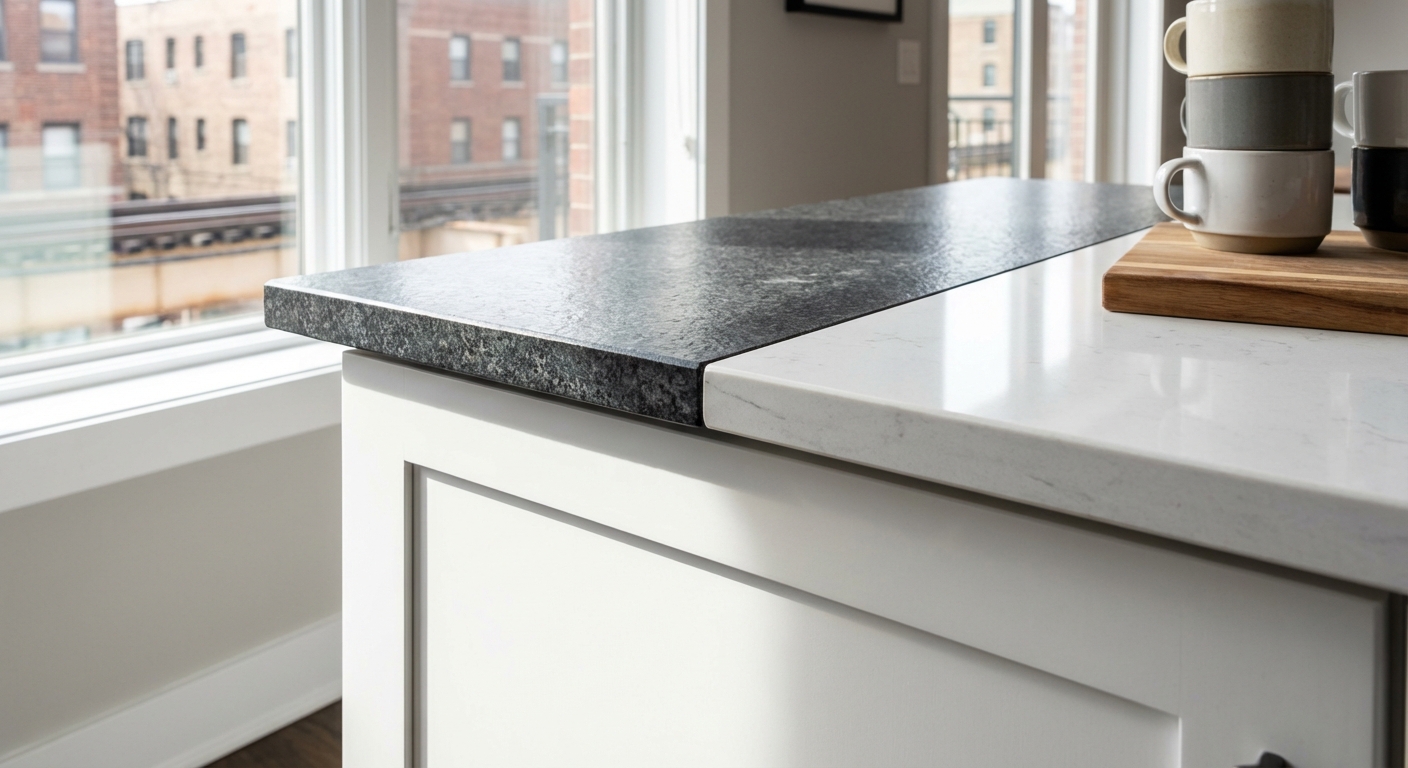
I started building cabinets in my father's workshop in Croatia 14 years ago, and even back then, countertop selection drove every cabinet design decision. Granite is 100% natural stone, quarried in massive slabs and cut to fit your kitchen. Every piece is unique. Quartz, on the other hand, is engineered — manufacturers like Caesarstone and Cambria combine roughly 93% crushed natural quartz with 7% polymer resin and pigments. This engineering process gives quartz its consistency and non-porous surface. Both materials are hard, heavy, and beautiful. But they behave very differently in a working kitchen, especially one in Chicago where indoor humidity can swing from 15% in January to 65% in August.
Granite's natural porosity means it can absorb liquids if the sealant wears off. In a humid Chicago summer, an unsealed granite slab can actually absorb moisture from the air, which over years can lead to dark spots near the sink. Quartz doesn't have this problem. Its resin binder creates a surface that repels water, wine, coffee, and pretty much anything your kids can throw at it. That said, granite handles heat far better. I've seen quartz surfaces discolor from a hot pan placed directly on the surface — the resin can scorch at temperatures above 300°F. Granite laughs at hot pans.
Cost Comparison: Chicago Pricing in 2026
Pricing in Chicago is different from national averages. Our labor costs are higher, fabrication shops charge more, and if you're in a walk-up condo, installers may charge extra for hauling a 400-lb slab up three flights of stairs. I track countertop costs carefully because they directly affect the total project budget when clients come to us for custom kitchen cabinets in Chicago. Below is what I'm seeing in the Chicago metro area right now.
| Factor | Granite | Quartz |
|---|---|---|
| Material cost per sq ft | $40-$150 | $45-$135 |
| Fabrication and install per sq ft | $10-$50 | $10-$40 |
| Total installed per sq ft | $50-$200 | $55-$175 |
| Average 40 sq ft kitchen | $2,000-$8,000 | $2,200-$7,000 |
| Annual sealing cost | $50-$100 | $0 |
| Expected lifespan | 50+ years | 25-30 years |
Exotic granites — think Blue Bahia or Van Gogh — can push past $200 per square foot. On the quartz side, premium brands like Dekton or high-end Cambria patterns can reach $175. For most of our clients doing a full kitchen remodel starting at $15,000, mid-range options in either material give the best balance of beauty and budget. The National Kitchen and Bath Association reports that countertops typically account for 10-15% of a total kitchen remodel budget, and that holds true for Chicago projects in my experience.
Need expert advice? Call (224) 808-5100 or schedule a free kitchen design consultation.
How Chicago's Climate Affects Each Material
Chicago is brutal on building materials. I say this with 14 years of experience — and the last 8 of those spent specifically observing how materials perform in this city's extremes. In winter, forced-air heating drops indoor humidity below 20%. In summer, without a dehumidifier, kitchens near Lake Michigan can sit above 60% humidity for months. Granite, being porous, expands and contracts microscopically with these moisture changes. Over 10-15 years, I've seen hairline cracks develop in granite countertops near windows that get direct afternoon sun — the thermal cycling stresses the stone.
Quartz is more dimensionally stable because the resin binding holds the material together during temperature swings. However, quartz has its own weakness in Chicago kitchens: direct sunlight. If your kitchen faces south or west — common in Lincoln Park greystones and Wicker Park two-flats — prolonged UV exposure can cause certain quartz colors to yellow over time. Manufacturers have improved UV resistance significantly, but I still recommend lighter quartz shades for sun-drenched kitchens. For north-facing kitchens, like most Chicago bungalows in Irving Park or Portage Park, either material performs well.
- High-humidity kitchens (near lake, garden-level units): Quartz wins — zero porosity means zero moisture absorption.
- Sun-drenched kitchens (south/west-facing windows): Granite wins — natural stone doesn't yellow from UV.
- Kitchens with heavy cooking and hot pots: Granite wins — handles heat up to 1,200°F without damage.
- Family kitchens with kids: Quartz wins — never needs sealing, resists stains from juice and markers.
Pairing Granite with Custom Cabinets
Granite's natural variation is its greatest strength and its biggest design challenge. Every slab has movement — veining, flecks, color shifts — and that movement needs to harmonize with your cabinet doors and finishes. I always tell clients: if your granite has a lot going on, simplify the cabinet design. Flat-panel or Shaker doors in a solid color work beautifully. When I build custom cabinets for Chicago homes, I bring a sample door to the stone yard so we can see the pairing under natural light, not showroom LEDs.
For dark granites like Absolute Black or Black Galaxy, I recommend white or light gray cabinets. The contrast is timeless and makes smaller Chicago kitchens feel larger. For warm-toned granites like Giallo Ornamental or Santa Cecilia, medium-toned wood stains — think maple or cherry — create a cohesive, classic look. Heavily veined granites like Typhoon Bordeaux pair best with very simple, unadorned cabinet fronts so the stone remains the focal point. One detail many people overlook: granite edge profiles. A heavy ogee edge on granite next to a minimalist slab-front cabinet looks disjointed. I always match the edge profile to the cabinet style — eased or straight edges for modern, slightly beveled for transitional.
Structurally, granite's weight demands sturdy cabinet construction. I build all our base cabinets with 3/4-inch plywood boxes, never particleboard, and I add corner bracing for countertop spans exceeding 36 inches without support. Our kitchen cabinet dimensions guide covers the specifics of how we engineer base units for heavy stone countertops.
Pairing Quartz with Custom Cabinets
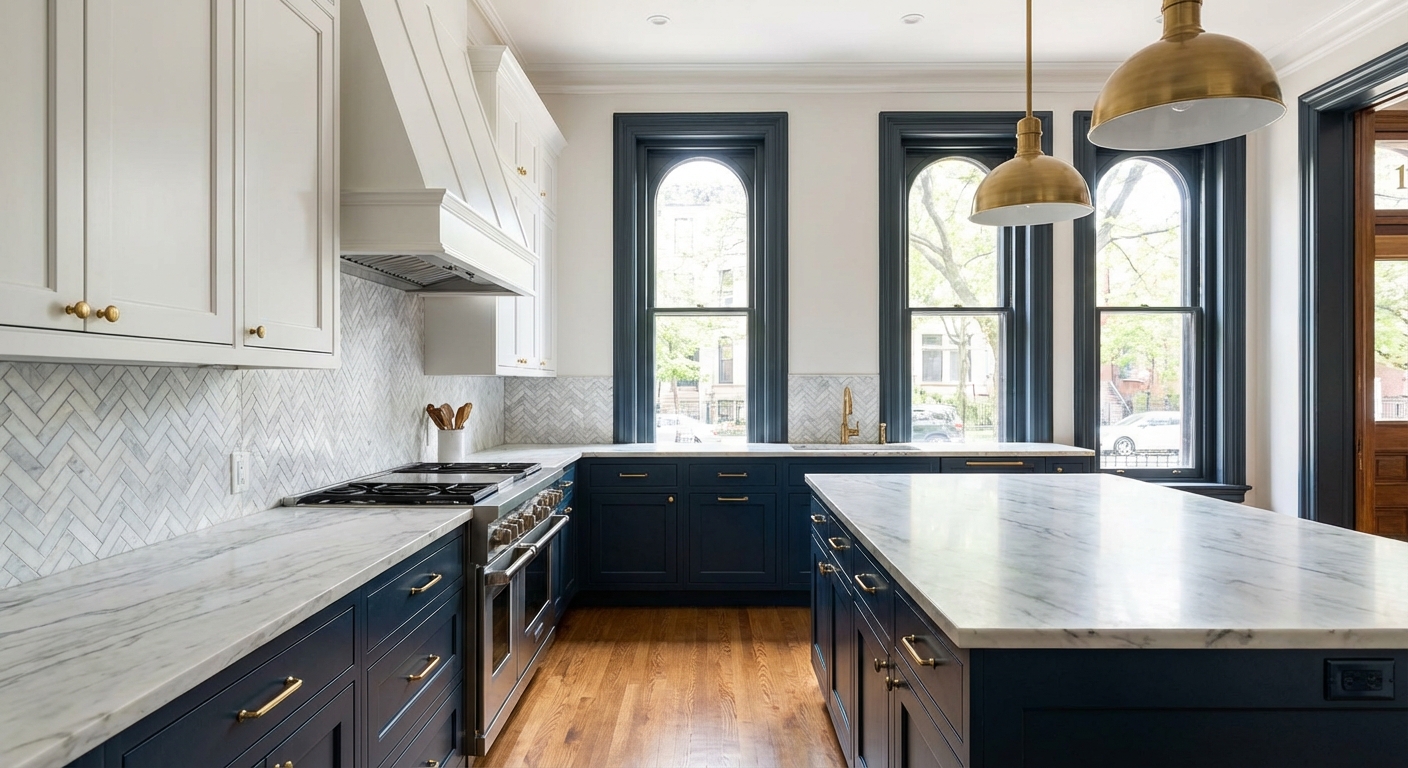
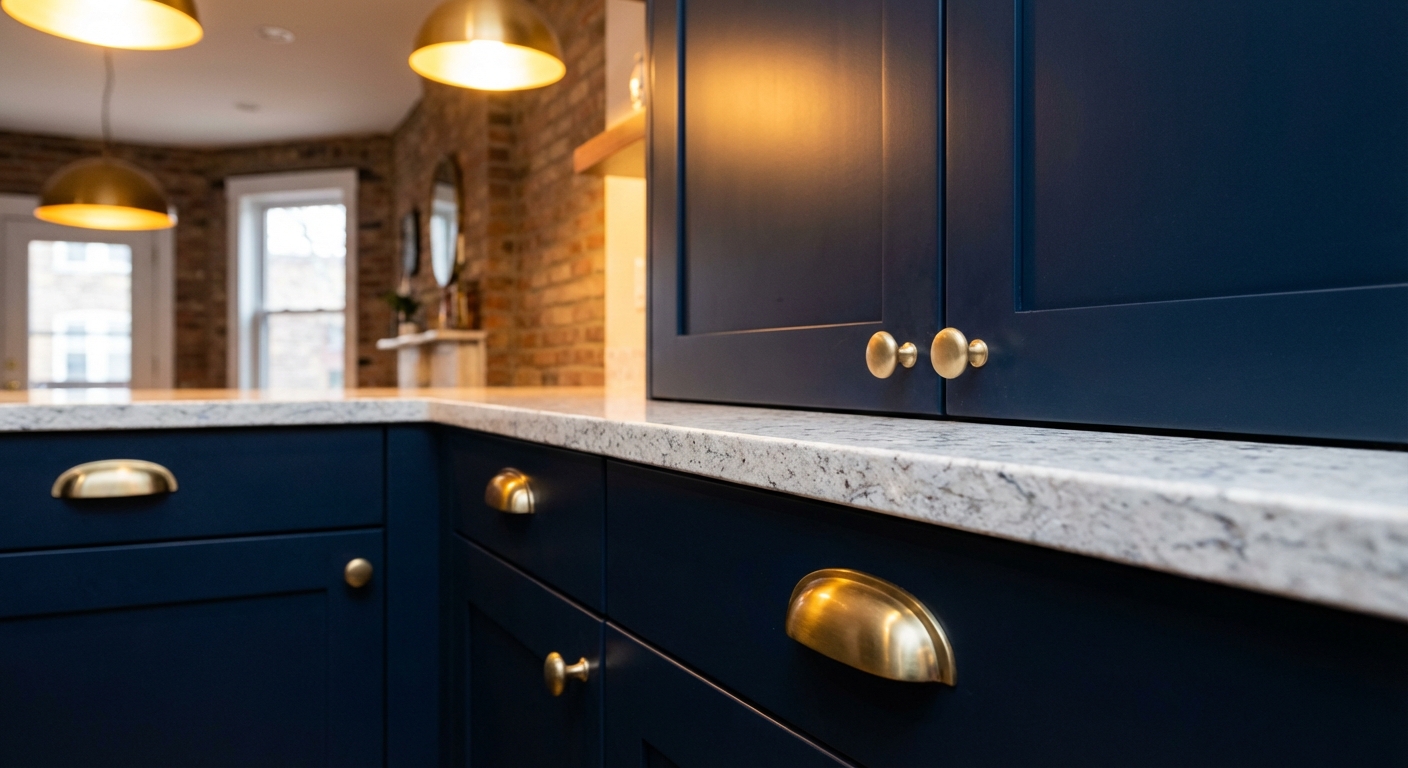
Quartz gives you design control that granite simply can't. Because it's engineered, you can get a perfectly consistent color across your entire kitchen — no surprises when the second slab doesn't match the first. This consistency makes quartz easier to pair with bold cabinet choices. I've been installing more deep navy, forest green, and even black cabinets in 2026, and these dramatic colors look stunning against a clean white or subtle-veined quartz like Calacatta-style patterns. The quartz provides visual rest while the cabinets make the statement.
For clients choosing two-tone kitchen designs — a trend that's still growing in Chicago — quartz is ideal because you can use the same countertop across both cabinet colors, and it unifies the entire space. I recently completed a Bucktown loft kitchen where we paired charcoal lower cabinets with white uppers, all tied together by a single Cambria Brittanicca quartz that mimicked marble veining. The result was cohesive and high-end. Hardware matters too. I specify Blum soft-close hinges and drawer systems on every project because the smooth, silent operation matches the refined aesthetic that quartz brings to a kitchen.
Quartz also outperforms granite for waterfall-edge islands — where the countertop cascades down the side of the island to the floor. The engineered consistency means the waterfall panel matches the top surface perfectly. With granite, a waterfall edge can look mismatched because adjacent cuts from the same slab still show natural variation. For island-centric kitchens — and almost every Chicago kitchen I build now centers on an island — quartz gives a cleaner result.
Durability and Maintenance: A 10-Year Outlook
I think about cabinets and countertops on a 10-year-plus timeline because that's how long you'll live with these choices. Granite requires annual sealing with a quality impregnating sealer — takes about 30 minutes and costs $50-$100 if you hire someone, or $15-$20 for a bottle of StoneTech BulletProof if you do it yourself. Skip the sealing, and you'll see stains around the stove and sink within 2-3 years. Chips in granite can be repaired with color-matched epoxy, but the fix is visible if you look closely.
Quartz needs nothing beyond daily cleaning with mild soap and water. No sealing, no special products, no annual maintenance appointments. Over 10 years, that convenience saves you roughly $500-$1,000 in sealing costs alone compared to granite — not huge savings, but the real value is the time and worry you don't spend. That said, quartz can be damaged by extreme heat and harsh chemicals. I've repaired quartz surfaces scorched by crock pots and bleach spills. These repairs are harder than granite repairs because you often need to replace an entire section.
- Scratch resistance: Granite rates 6-7 on the Mohs hardness scale; quartz rates 7. Both are excellent.
- Stain resistance: Quartz superior — non-porous surface repels all liquids without sealing.
- Heat resistance: Granite superior — use trivets on quartz, always.
- Chip resistance: Quartz slightly better — resin provides flex that natural stone lacks.
- Repairability: Granite easier to spot-repair; quartz often requires section replacement.
Resale Value in the Chicago Market
Both granite and quartz add value to a Chicago home, but the market is shifting. Five years ago, granite was the gold standard that real estate agents highlighted in listings. Today, quartz has pulled ahead in buyer preference, especially among younger buyers in neighborhoods like Logan Square, Avondale, and Humboldt Park. According to data from local listing descriptions I track, roughly 60% of renovated Chicago kitchens listed in 2025-2026 feature quartz countertops. Granite still commands strong value, particularly in traditional-style homes in Edison Park, Beverly, and the North Shore suburbs.
The cabinet-countertop pairing matters enormously for resale. A cohesive kitchen where the countertops, cabinets, hardware, and backsplash tell one clear design story sells faster than a kitchen with disconnected elements. That's exactly why I encourage clients to plan cabinets and countertops together from day one. When you work with our team, we consider both elements simultaneously. Browse our completed Chicago kitchen projects to see how we pair materials across different styles. A well-paired kitchen remodel in Chicago can recoup 60-80% of its cost at resale, based on current market data from the NKBA.
My Recommendation as a Craftsman
After pairing both materials with cabinets across 1,300+ projects, here's my honest recommendation. Choose quartz if you want a low-maintenance kitchen that looks consistent and modern for the next two decades. Choose granite if you love natural stone's organic beauty and you're willing to invest 30 minutes a year in sealing. Neither choice is wrong — they're different tools for different goals. The critical factor most people overlook is the cabinet construction beneath the countertop. A stunning countertop on cheap cabinets is like putting a Ferrari body on a golf cart frame. It looks great until the first pothole.
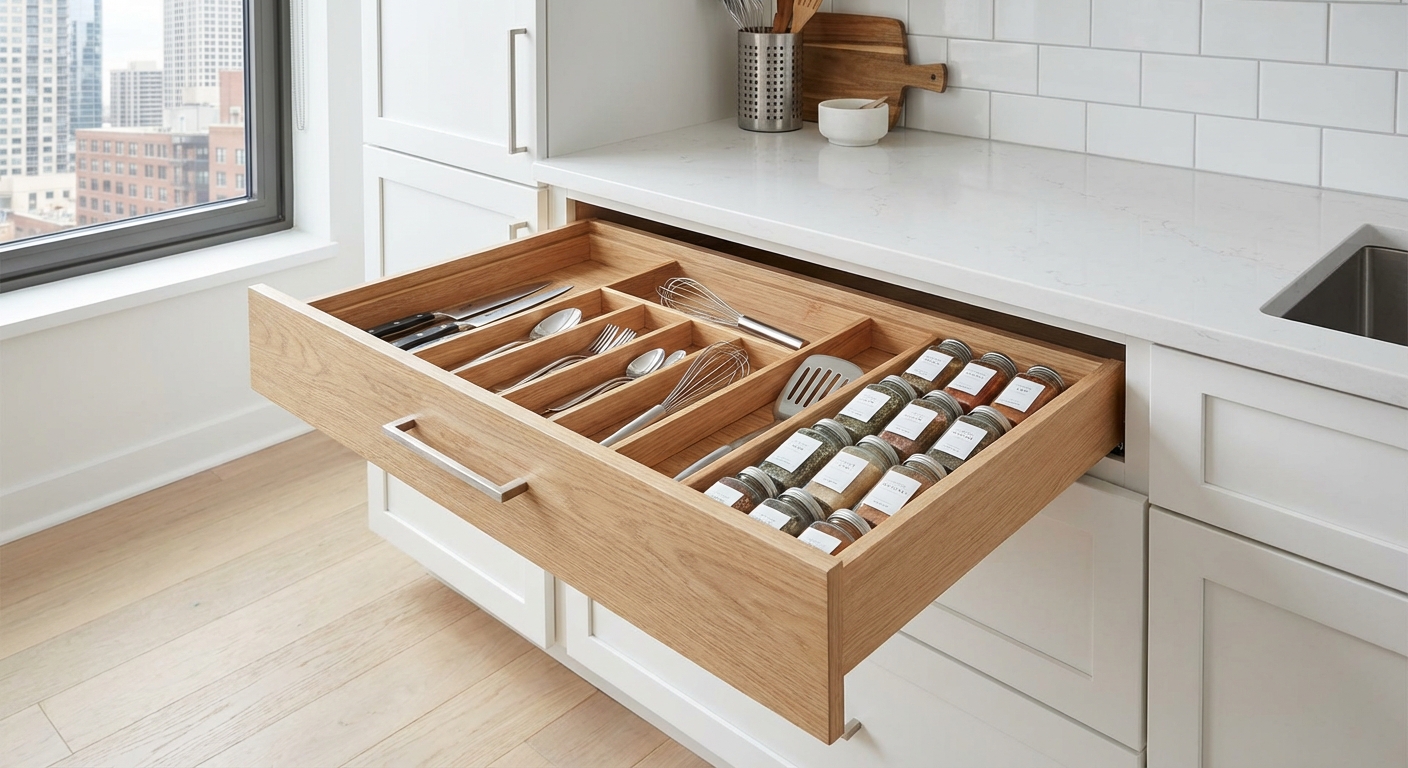
At AK Cabinet Craft, every cabinet box we build uses 3/4-inch plywood with dovetail drawer construction and Blum TANDEMBOX drawer systems from Austria — built to handle the weight and daily abuse that heavy stone countertops demand. Our custom built-ins guide explains how we approach cabinetry for every room, not just kitchens. We back everything with a 5-year warranty and deliver in just 21 days from final design approval.
Frequently Asked Questions
Is quartz or granite better for a bathroom vanity in Chicago?
For bathroom vanities, I almost always recommend quartz. Bathrooms are the highest-humidity room in any Chicago home, and quartz's non-porous surface handles that moisture without any sealing. Granite works, but you'll need to be diligent about annual sealing to prevent water damage around the sink.
Can I put granite or quartz countertops on existing cabinets?
It depends on the cabinet construction. If your existing cabinets are solid plywood with good structural integrity, yes. If they're particleboard or thermofoil cabinets that are delaminating — very common in Chicago condos built in the 2000s — I recommend replacing the cabinets first. A 400-lb granite slab on weak cabinets is a safety risk.
How long does countertop installation take after cabinets are in?
Templating happens 3-5 days after cabinet installation to allow everything to settle. Fabrication takes 5-10 business days. Installation itself takes 3-6 hours depending on kitchen size and complexity. Total from cabinets-complete to countertops-done is typically 2-3 weeks.
Does cabinet color affect countertop pricing?
No. Your cabinet finish has zero effect on countertop cost. But I've seen clients overspend on exotic countertops and then skimp on cabinets, which is a mistake. The cabinets are the foundation. Budget them first, then allocate 10-15% of the remaining budget for countertops.
What countertop material pairs best with a closet or pantry system?
For custom closets and pantry systems, I typically use laminate or butcher block for any built-in counter surfaces. Stone countertops are overkill in a closet. Save your granite or quartz budget for the kitchen and bathrooms where it delivers the most value.
Ready to Get Started?
Whether you're leaning toward granite or quartz, the right countertop starts with the right cabinets beneath it. At AK Cabinet Craft, I'll help you match materials, plan dimensions, and build a kitchen that holds up to Chicago's climate for decades. Schedule a free kitchen design consultation or call (224) 808-5100 — and bring your countertop samples. I'll show you exactly how they look against our door styles.